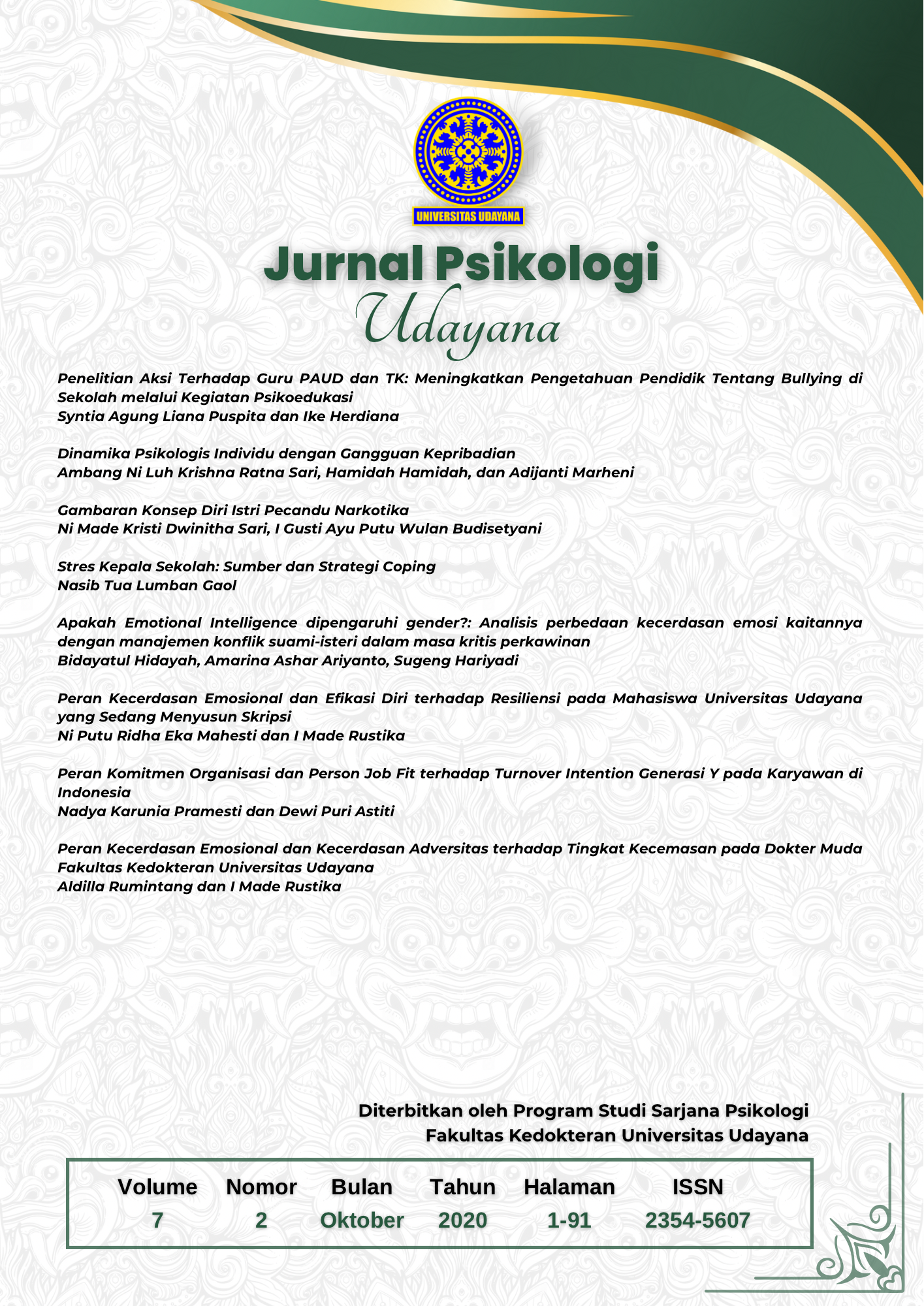
Dinamika Psikologis Individu dengan Gangguan Kepribadian Ambang
DOI:
https://doi.org/10.24843/JPU.2020.v07.i02.p02Abstrak
Borderline personality disorder is one of the personality disorders that is widely encountered in psychiatric and psychological practices. This research aims to explore the psychological dynamics of individuals with borderline personality disorder based on the results of the assessment. The subject in this study is a 24-years-old man that showed the symptoms of borderline personality disorder. The research method used is qualitative with a case study approach. Data were collected through psychological assessment including interviews, observations, and some psychological tests such as graphic tests (BAUM, DAP, and HTP), SPM (Standart Progressive Matrices), SSCT (Sack's Sentence Completion Test), and Drawing Completion Test (DCT). The results showed that the subject had personality aspects such as emotional instability, low control of psychological drive, and the need to depend on others. Subjects have traumatic experiences such as abuse and early separation with parental figures, family dysfunction as well as unsupportive environmental factors. Interactions between these two conditions illustrate the psychological dynamics of the symptoms of borderline personality disorders addresses by subject.
Keywords : Borderline personality disorder, traumatic experiences, young adulthood.
Unduhan
Diterbitkan
Terbitan
Bagian
Lisensi
Hak Cipta (c) 2026 Jurnal Psikologi Udayana

Artikel ini berlisensiCreative Commons Attribution-ShareAlike 4.0 International License.
Authors who publish with this journal agree to the following terms:
- Authors retain copyright and grant the journal right of first publication with the work simultaneously licensed under a Creative Commons Attribution-ShareAlike 4.0 International License that allows others to share the work with an acknowledgement of the works authorship and initial publication in this journal.
- Authors are able to enter into separate, additional contractual arrangements for the non-exclusive distribution of the journals published version of the work (e.g., post it to an institutional repository or publish it in a book), with an acknowledgement of its initial publication in this journal.
- Authors are permitted and encouraged to post their work online (e.g., in institutional repositories or on their website) prior to and during the submission process, as it can lead to productive exchanges, as well as earlier and greater citation of published work (See The Effect of Open Access).