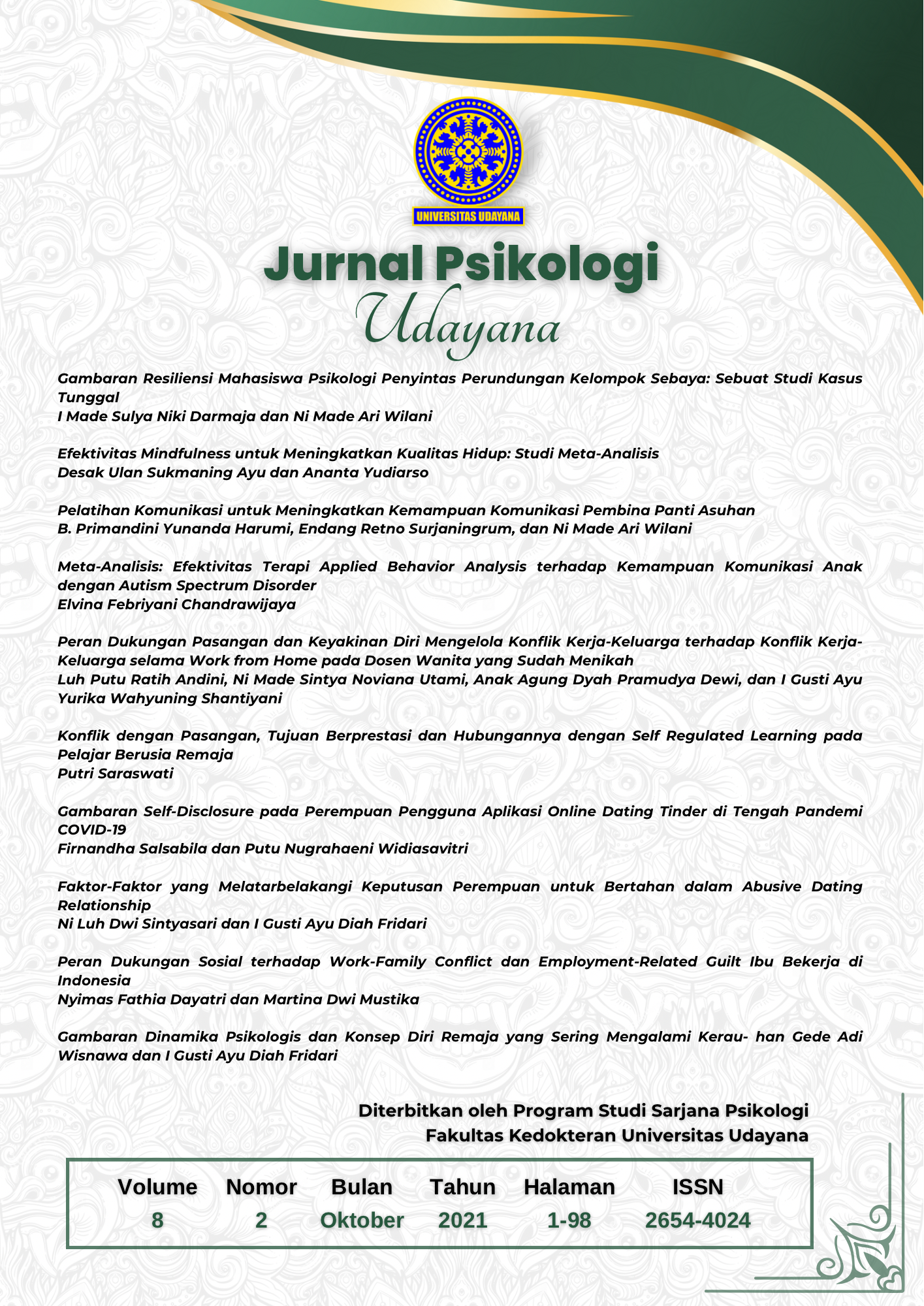
Peran dukungan pasangan dan keyakinan diri mengelola konflik kerja-keluarga terhadap konflik kerja-keluarga selama work fromhome pada dosen wanita yang sudah menikah
DOI:
https://doi.org/10.24843/JPU.2021.v08.i02.p05Abstrak
Work-family conflict have been strongly felt by married female lecturers in the midst of the Covid-19 virus pandemic. Lecturers must carry out their duties from home, besides that they also have the task of taking care of children and husbands at home. Work-family conflict can be affected by work family conflict self-efficacy and spouse support. The purpose of this study was to see the relationship between the two variables (work-family conflict self-efficacy and spouse support) simultaneously on work-family conflict in married female lecturers. Subject totaled 21 female lecturers who worked as lecturers at a university. Researchers used the work family conflict, the work family conflict self-efficacy, and spouse support scale. The results obtained by R square = 0.428 means that work-family conflict self-efficacy and spouse support has a role as much as 42.8% in explaining work-family conflict. R value = 0.654; F = 6737; and p = 0.007 ?<0.05 where the hypothesis is accepted, meaning that there is a significant role between work-family conflict, self-efficacy, and spouse support for work-family conflict in married female lecturers at University X during work from home. The Beta value shows that spouse support has a higher value that affects work-family conflict than work-family conflict self-efficacy.
Unduhan
Diterbitkan
Terbitan
Bagian
Lisensi
Hak Cipta (c) 2026 Jurnal Psikologi Udayana

Artikel ini berlisensiCreative Commons Attribution-ShareAlike 4.0 International License.
Authors who publish with this journal agree to the following terms:
- Authors retain copyright and grant the journal right of first publication with the work simultaneously licensed under a Creative Commons Attribution-ShareAlike 4.0 International License that allows others to share the work with an acknowledgement of the works authorship and initial publication in this journal.
- Authors are able to enter into separate, additional contractual arrangements for the non-exclusive distribution of the journals published version of the work (e.g., post it to an institutional repository or publish it in a book), with an acknowledgement of its initial publication in this journal.
- Authors are permitted and encouraged to post their work online (e.g., in institutional repositories or on their website) prior to and during the submission process, as it can lead to productive exchanges, as well as earlier and greater citation of published work (See The Effect of Open Access).