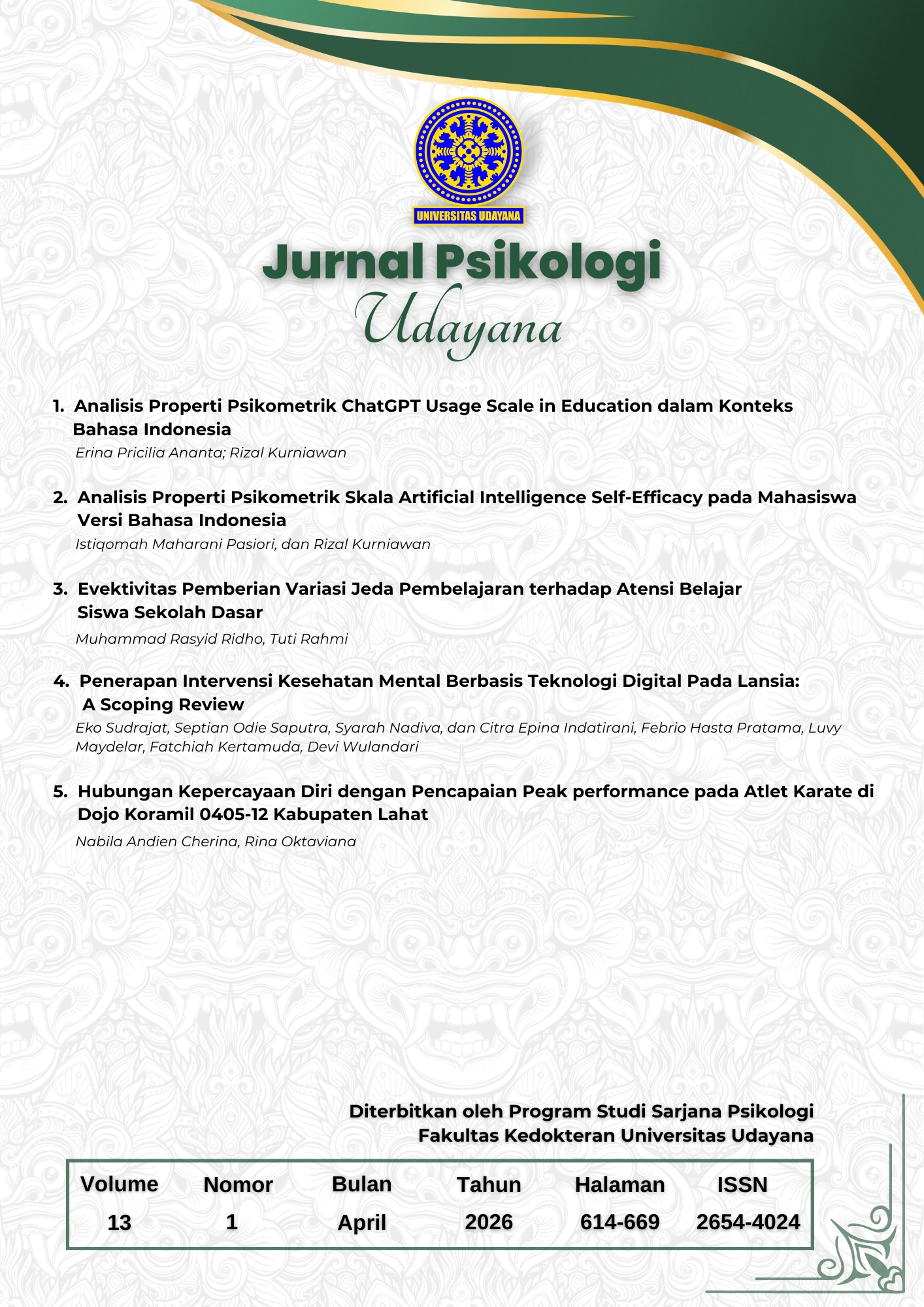
Psychometric Properties Analysis of the Artificial Intelligence Self-Efficacy Scale for University Students in Indonesian
DOI:
https://doi.org/10.24843/JPU.2026.v13.i01.p02Keywords:
Artificial Intelligence, Psychometric, Self-EfficacyAbstract
This study aims to analyze the psychometric properties of the Indonesian version of the Artificial Intelligence Self-Efficacy Scale (AISES) among university students. The adaptation refers to the International Test Commission (2017) guidelines, and content validity is analyzed using Aiken's V method to ensure conceptual and semantic appropriateness. This study involved 560 students in Indonesia as subjects, with sample selection using non-probability sampling techniques in the form of purposive sampling. This study successfully confirmed the internal structure of AISES using Exploratory Factor Analysis (EFA) and Confirmatory Factor Analysis (CFA), which consisted of four dimensions, namely Assistance, Anthropomorphic Interaction, Comfort with AI, and Technological Skills with a good model fit index (CFI = 0.914, TLI = 0.902, RMSEA = 0.061, SRMR = 0.063). Despite removing one item in the Technological Skills dimension, the Indonesian version of AISES has a fairly high reliability coefficient with Cronbach's α = 0.908 and McDonald's ω = 0.916. The results show that the Indonesian version of AISES is a valid and adequate instrument for measuring self-efficacy towards AI in the student population.
Downloads
Published
Issue
Section
License
Copyright (c) 2026 Jurnal Psikologi Udayana

This work is licensed under a Creative Commons Attribution-ShareAlike 4.0 International License.
Authors who publish with this journal agree to the following terms:
- Authors retain copyright and grant the journal right of first publication with the work simultaneously licensed under a Creative Commons Attribution-ShareAlike 4.0 International License that allows others to share the work with an acknowledgement of the works authorship and initial publication in this journal.
- Authors are able to enter into separate, additional contractual arrangements for the non-exclusive distribution of the journals published version of the work (e.g., post it to an institutional repository or publish it in a book), with an acknowledgement of its initial publication in this journal.
- Authors are permitted and encouraged to post their work online (e.g., in institutional repositories or on their website) prior to and during the submission process, as it can lead to productive exchanges, as well as earlier and greater citation of published work (See The Effect of Open Access).