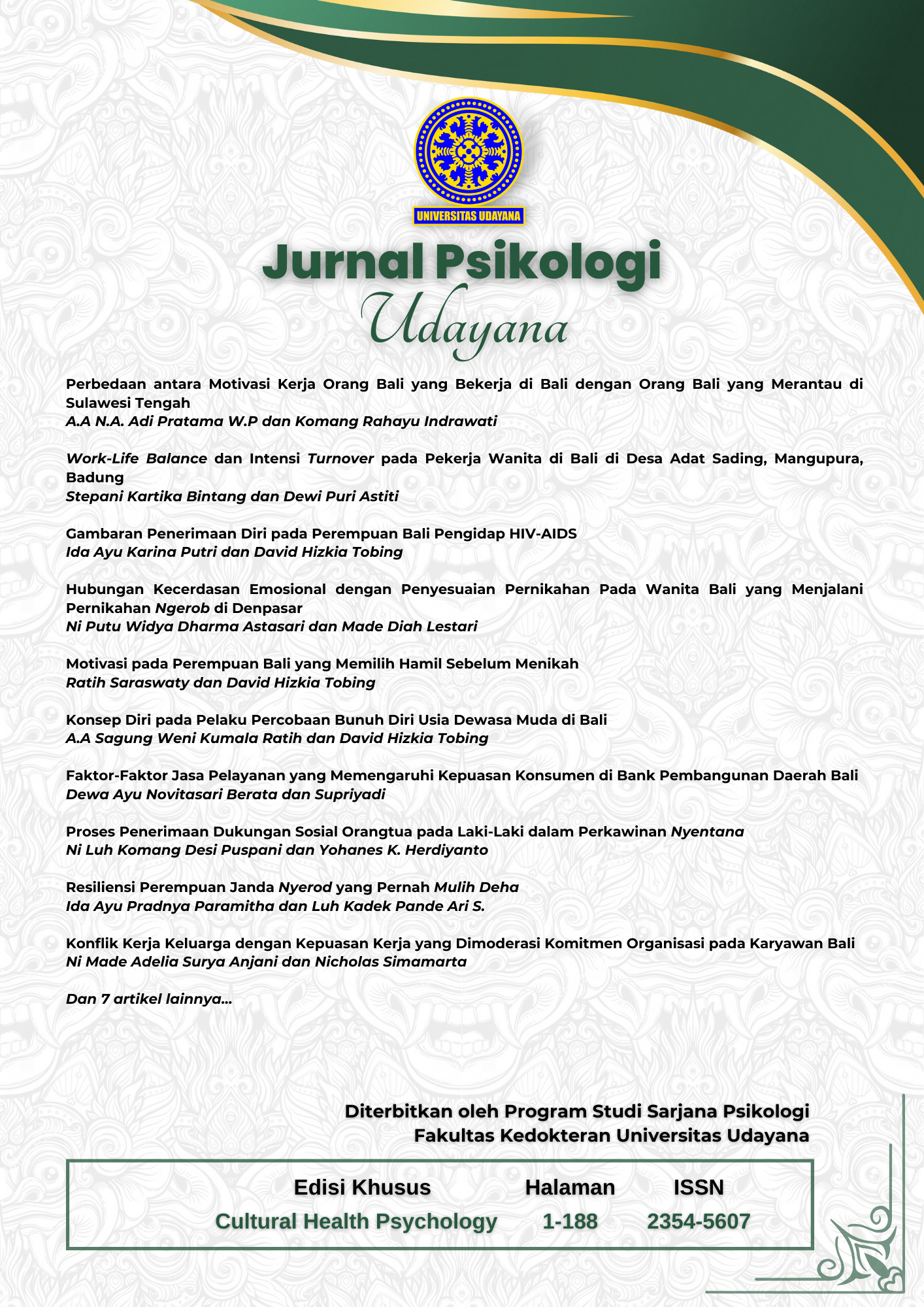
MOTIVASI PADA PEREMPUAN BALI YANG MEMILIH HAMIL SEBELUM MENIKAH
DOI:
https://doi.org/10.24843/Abstract
As a social human being, a human cannot live by him/her self; he/she needs somebody else to interact, socialize, and have a relationship, which eventually create new generations through sexual intercourse (Sumpami, 2008). Marriage is a physical and mental bonding between a man and a woman as a wife and a husband to build a happy and eternal family based on one almighty God. Bali is one of Indonesian provinces that still strongly hold its tradition. To have a child is a kind of requisite in Balinese marriage. A preliminary study conducted by a researcher on 2013 shows that 8 out of 20 Balinese women chose to get pregnant before marriage because of the requisition from their partner and partner’s parent (Saraswaty, 2013). Based on this fact, many study are having interest to find out Balinese women’s motivation to get pregnant before marriage.
This research used qualitative method with phenomenology design. Respondents are four Balinese women, which were chosen through purposive sampling method. The research results show that the interviewees have intrinsic and extrinsic motivation on deciding to get premarital pregnancy. The intrinsic motivation, consist of a feeling of have found perfect match, being accepted by partner’s parents, a desire to be loved deeper, felt appreciated and fidelity of partner, tried to prove that be able to have a baby. While the extrinsic motivation are a feeling of being scared of people’s contempt, afraid that her partner will get married again, motivated to get a better life, getting attention from partner and partner’s parents, and having grown up and responsible partner.
Key Words: Premarital Pregnancy, Motivation, Balinese Women.
Downloads
Published
Issue
Section
License
Copyright (c) 2026 Jurnal Psikologi Udayana

This work is licensed under a Creative Commons Attribution-ShareAlike 4.0 International License.
Authors who publish with this journal agree to the following terms:
- Authors retain copyright and grant the journal right of first publication with the work simultaneously licensed under a Creative Commons Attribution-ShareAlike 4.0 International License that allows others to share the work with an acknowledgement of the works authorship and initial publication in this journal.
- Authors are able to enter into separate, additional contractual arrangements for the non-exclusive distribution of the journals published version of the work (e.g., post it to an institutional repository or publish it in a book), with an acknowledgement of its initial publication in this journal.
- Authors are permitted and encouraged to post their work online (e.g., in institutional repositories or on their website) prior to and during the submission process, as it can lead to productive exchanges, as well as earlier and greater citation of published work (See The Effect of Open Access).