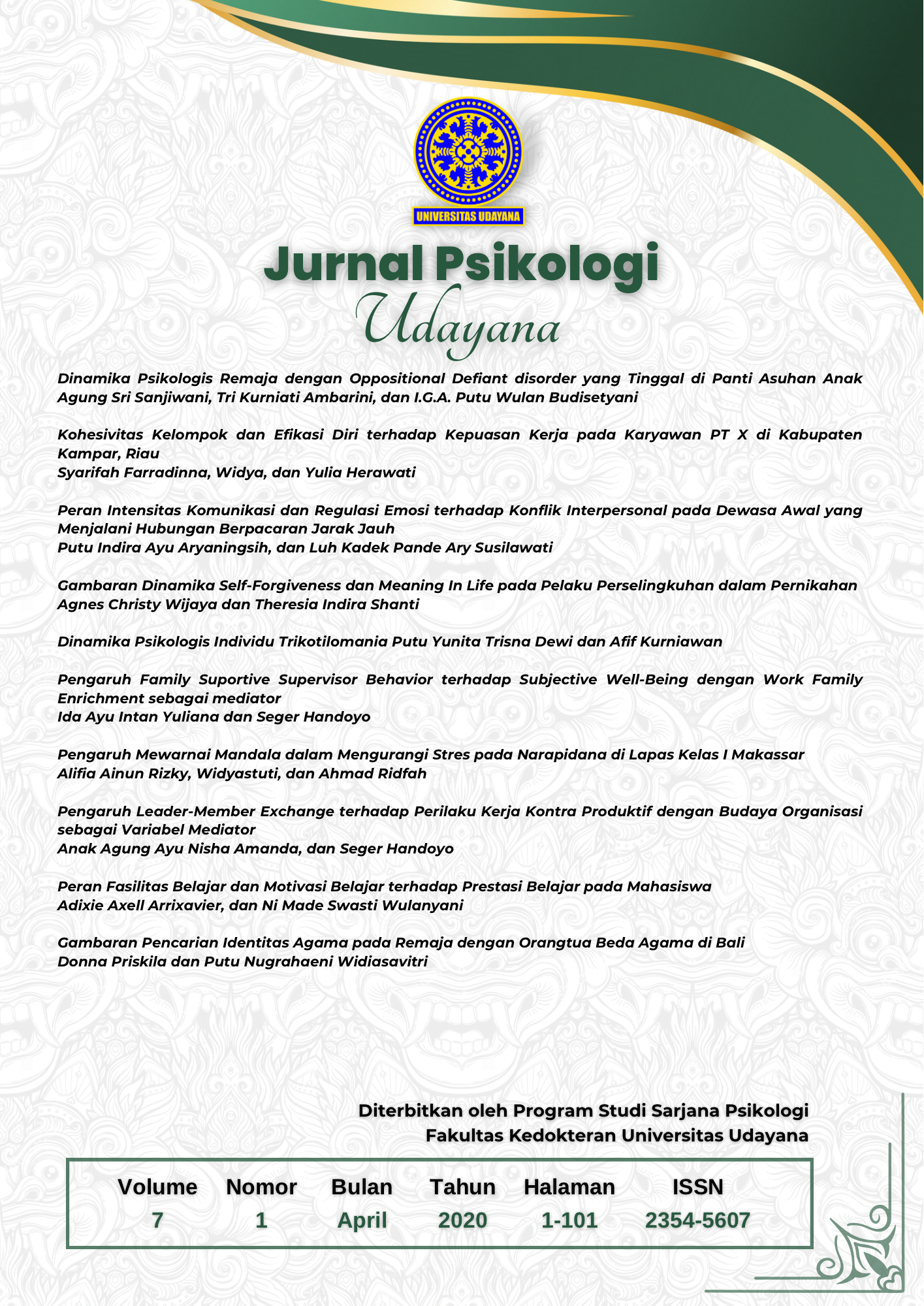
Peran intensitas komunikasi dan regulasi emosi terhadap konflik interpersonal pada dewasa awal yang menjalani hubungan berpacaran jarak jauh
DOI:
https://doi.org/10.24843/JPU.2020.v07.i01.p03Abstract
Courtship is a relationship that involves a greater and deeper intimacy and romantic feelings between two individuals who know each other. During the process, courtship cannot always be done closely due to education and careers in different areas that causes long distance relationship. The distance becomes an obstacle which triggers several conflicts. The situation of conflict always involves the communication process and emotional aspects. The influent communication tends to cause misunderstanding that lead to conflict. Uncontrolled emotion causes a dangerous conflict. This study applied quantitative method that discussed the role of communication intensity and emotion regulation toward interpersonal conflict at early adulthood undergoing long distance relationships. The subjects of study involved 307 adults who had long distance relationships. In this study, the scale of interpersonal conflict, communication intensity, and emotional regulation were applied as measuring instruments. Multiple regression technique was use to do data analysis. The results of multiple regression tests showed that a regression coefficient was 0,596; a coefficient value of determination was 0,355; and a significance value was 0,000 (p<0,05) with a standardized beta coefficient on the variable of communication intensity about -0,373 and emotion regulation about -0,348. These results indicate that communication intensity and emotion regulation take a role to decrease interpersonal conflict at early adulthood who have long distance relationships.
Downloads
Published
Issue
Section
License
Copyright (c) 2026 Jurnal Psikologi Udayana

This work is licensed under a Creative Commons Attribution-ShareAlike 4.0 International License.
Authors who publish with this journal agree to the following terms:
- Authors retain copyright and grant the journal right of first publication with the work simultaneously licensed under a Creative Commons Attribution-ShareAlike 4.0 International License that allows others to share the work with an acknowledgement of the works authorship and initial publication in this journal.
- Authors are able to enter into separate, additional contractual arrangements for the non-exclusive distribution of the journals published version of the work (e.g., post it to an institutional repository or publish it in a book), with an acknowledgement of its initial publication in this journal.
- Authors are permitted and encouraged to post their work online (e.g., in institutional repositories or on their website) prior to and during the submission process, as it can lead to productive exchanges, as well as earlier and greater citation of published work (See The Effect of Open Access).