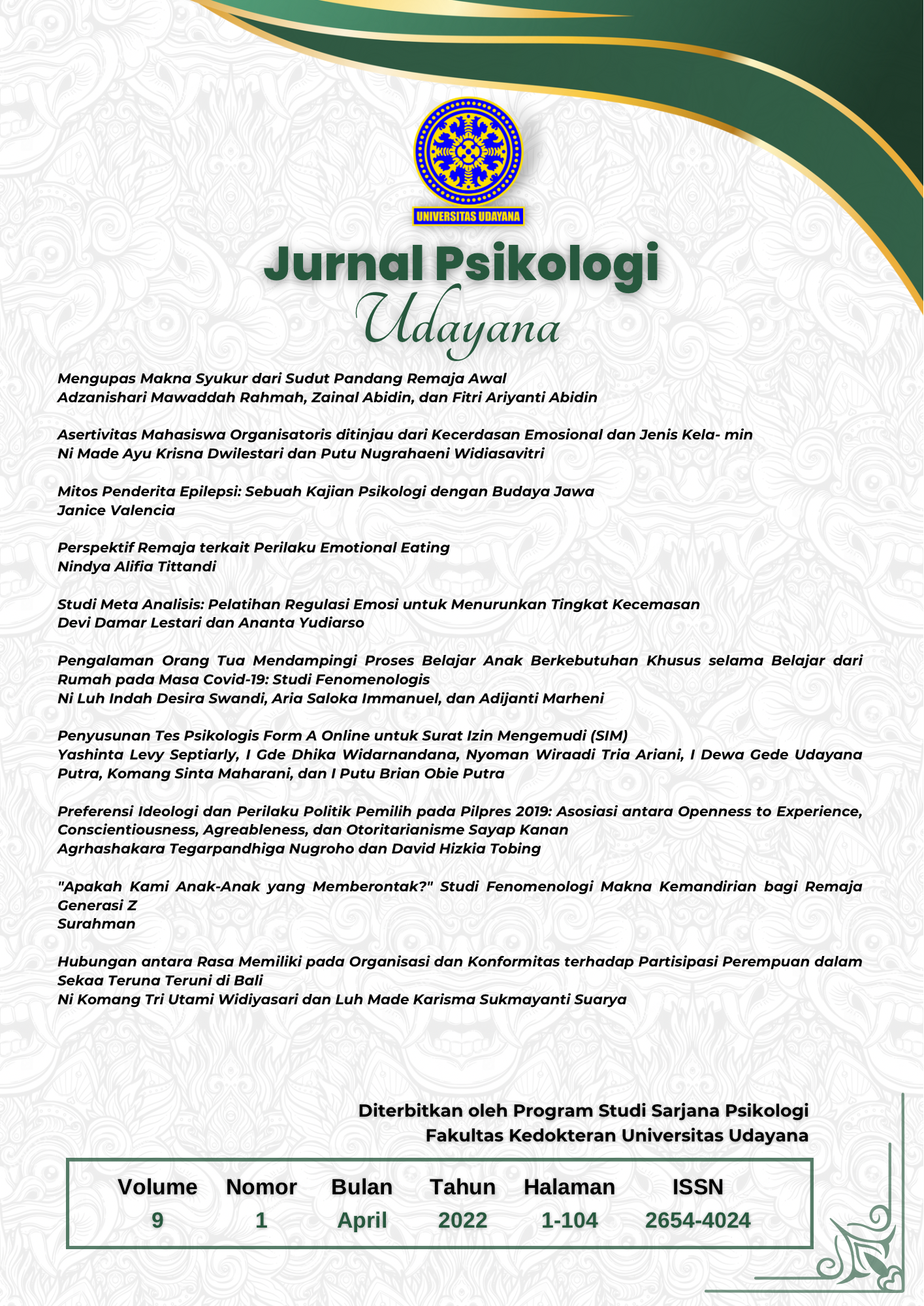
Mengupas makna syukur dari sudut pandang remaja awal
DOI:
https://doi.org/10.24843/JPU.2022.v09.i01.p01Abstract
Studies showed that gratitude can be used as an approach to prevent adolescent mental health problems. The concept of gratitude that was used generally refered to a concept from Western culture or a concept applied to adults. This study aimed to explore the concept of gratitude in early adolescents using qualitative methods. Respondents consisted of 22 boys and 45 girls aged 12 to 15 years. The instrument used was open-ended questionnaire about the meanings, objects, forms of expression, along with the affective sides of gratitude. Data were analyzed using thematic analysis. The result of this study indicated that the concept of gratitude interpreted by early adolescents was represented by four major categories, namely thanking and praising God, accepting, enjoying, and appreciating. The object of gratitude were gifts of God, valuable objects, academic achievements, and social relations. Whereas expressions of gratitude were expressed by praying, verbalizing, worshiping God, developing oneself, and doing positive things to others. These finding showed that the concept of gratitude for early adolescents in Indonesia is closely related to divinity and morals but still intact with the characteristics of adolescent development.
Downloads
Published
Issue
Section
License
Copyright (c) 2026 Jurnal Psikologi Udayana

This work is licensed under a Creative Commons Attribution-ShareAlike 4.0 International License.
Authors who publish with this journal agree to the following terms:
- Authors retain copyright and grant the journal right of first publication with the work simultaneously licensed under a Creative Commons Attribution-ShareAlike 4.0 International License that allows others to share the work with an acknowledgement of the works authorship and initial publication in this journal.
- Authors are able to enter into separate, additional contractual arrangements for the non-exclusive distribution of the journals published version of the work (e.g., post it to an institutional repository or publish it in a book), with an acknowledgement of its initial publication in this journal.
- Authors are permitted and encouraged to post their work online (e.g., in institutional repositories or on their website) prior to and during the submission process, as it can lead to productive exchanges, as well as earlier and greater citation of published work (See The Effect of Open Access).