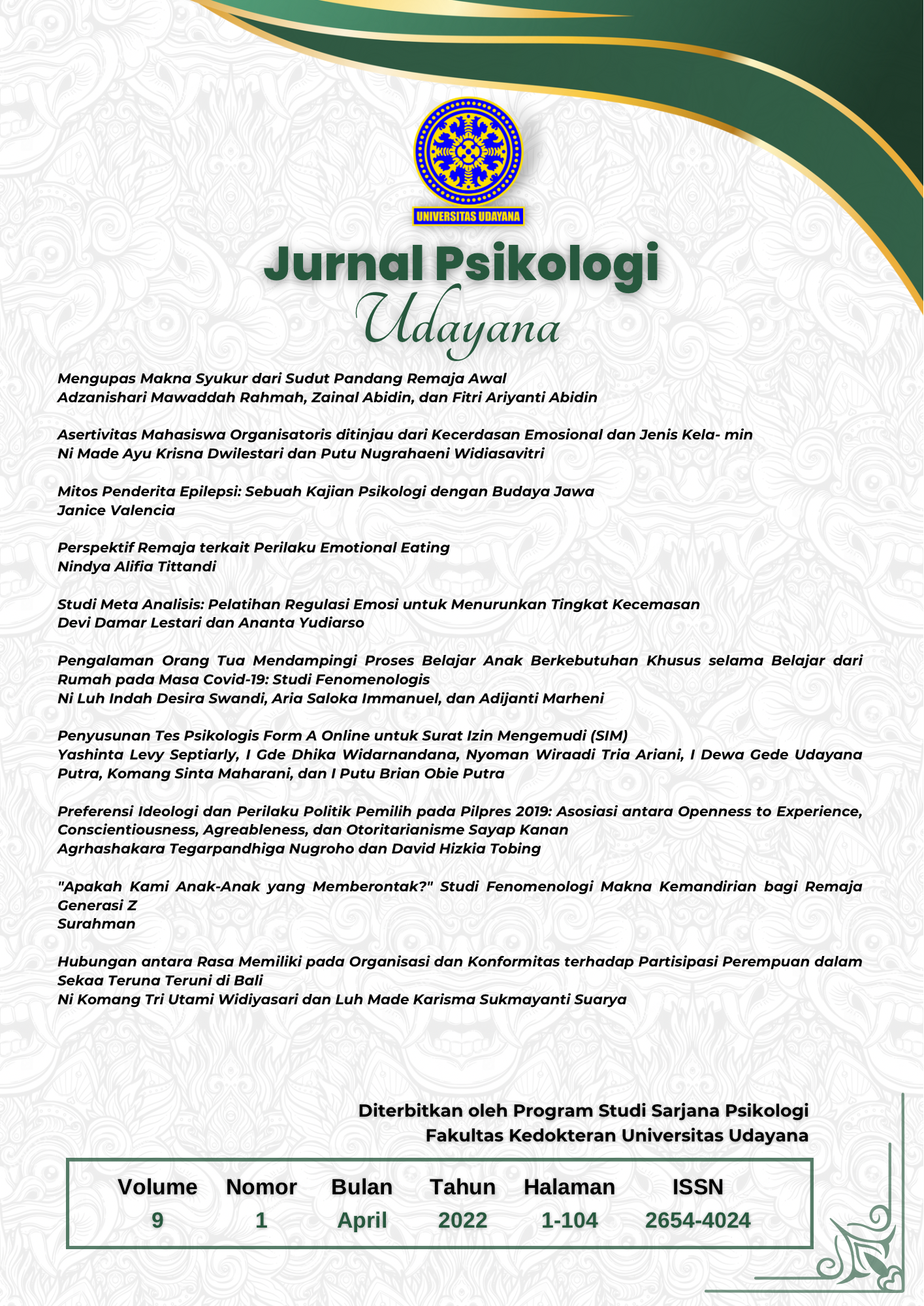
Pengalaman orang tua mendampingi proses belajar anak berkebutuhan khusus selama belajar dari rumah pada masa COVID-19: Studi fenomenologis
DOI:
https://doi.org/10.24843/JPU.2022.v09.i01.p06Abstract
This study aims to understand how parents interpret experiences in assisting children with special needs to learn from home. This research method is phenomenological qualitative with data collection in the form of semi-structured interviews. Interviews were conducted online with three parents of children with special needs obtained by the purposive sampling method. The data obtained were then transcribed and analyzed by Interpretative Phenomenological Analysis (IPA). The results showed that there were several superordinate themes, namely: (1) parents' views on the child's condition, (2) difficulties faced while accompanying children to study, (3) emotional experiences while accompanying children, (4) relationship and social support obtained and expected by parents, (5) worries and future expectation. In this study, parents conveyed their personal experiences and feelings in accompanying children while learning from home. This finding can contribute to the field of educational and clinical psychology as a basis for providing appropriate interventions for parents in assisting children with special needs to learn from home.
Keywords: Children with special needs, learning from home, Covid-19, interpretative phenomenological analysis, parents' experience
Downloads
Published
Issue
Section
License
Copyright (c) 2026 Jurnal Psikologi Udayana

This work is licensed under a Creative Commons Attribution-ShareAlike 4.0 International License.
Authors who publish with this journal agree to the following terms:
- Authors retain copyright and grant the journal right of first publication with the work simultaneously licensed under a Creative Commons Attribution-ShareAlike 4.0 International License that allows others to share the work with an acknowledgement of the works authorship and initial publication in this journal.
- Authors are able to enter into separate, additional contractual arrangements for the non-exclusive distribution of the journals published version of the work (e.g., post it to an institutional repository or publish it in a book), with an acknowledgement of its initial publication in this journal.
- Authors are permitted and encouraged to post their work online (e.g., in institutional repositories or on their website) prior to and during the submission process, as it can lead to productive exchanges, as well as earlier and greater citation of published work (See The Effect of Open Access).