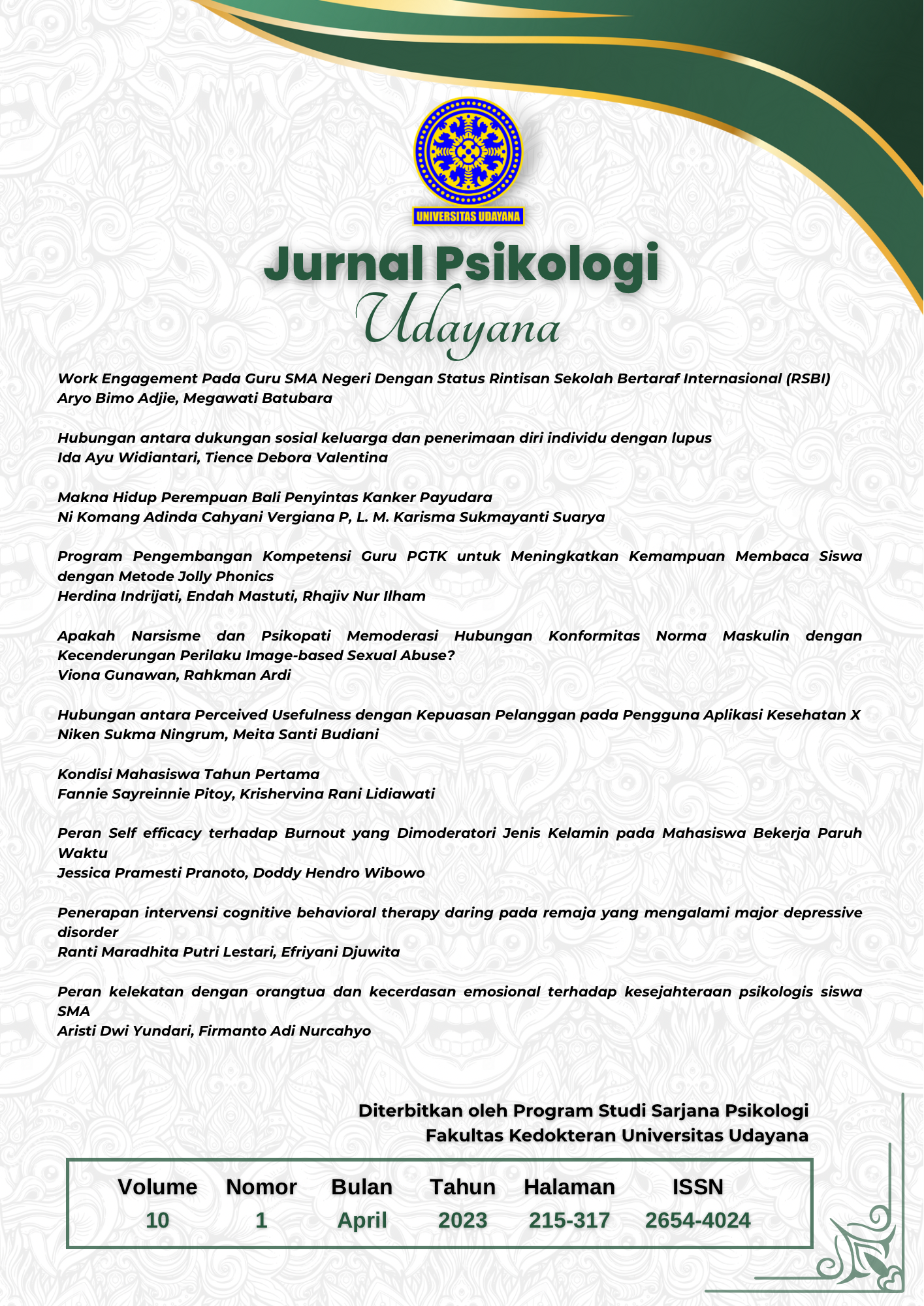
Program Pengembangan Kompetensi Guru PGTK untuk Meningkatkan Kemampuan Membaca Siswa dengan Metode Jolly Phonics
DOI:
https://doi.org/10.24843/JPU.2023.v10.i01.p04Abstract
Lately, problems related to pupils’ reading skill at school is increasing. So, teachers have to give more attention to the addressed problems. This study aims to examine the effectivity of the training for kindergarten teacher to uplift pupils’ reading skill through the jolly phonics method. This study involved 29 participants who work as kindergarten teacher in Jember. The training consisted of the presentation from experts, group discussion, role play, pre-test, and post-test. Data was analyzed using Wilcoxon Signed Ranks Test to examine the score difference before and after the training was implemented. Result shows that there is significant increasement (p=0,000) of the participants’ score after the training was implemented. Result of this study could be used as additional reference for implementing jolly phonics method to increase reading skill of the pupils at school.
Downloads
Published
Issue
Section
License
Copyright (c) 2026 Jurnal Psikologi Udayana

This work is licensed under a Creative Commons Attribution-ShareAlike 4.0 International License.
Authors who publish with this journal agree to the following terms:
- Authors retain copyright and grant the journal right of first publication with the work simultaneously licensed under a Creative Commons Attribution-ShareAlike 4.0 International License that allows others to share the work with an acknowledgement of the works authorship and initial publication in this journal.
- Authors are able to enter into separate, additional contractual arrangements for the non-exclusive distribution of the journals published version of the work (e.g., post it to an institutional repository or publish it in a book), with an acknowledgement of its initial publication in this journal.
- Authors are permitted and encouraged to post their work online (e.g., in institutional repositories or on their website) prior to and during the submission process, as it can lead to productive exchanges, as well as earlier and greater citation of published work (See The Effect of Open Access).