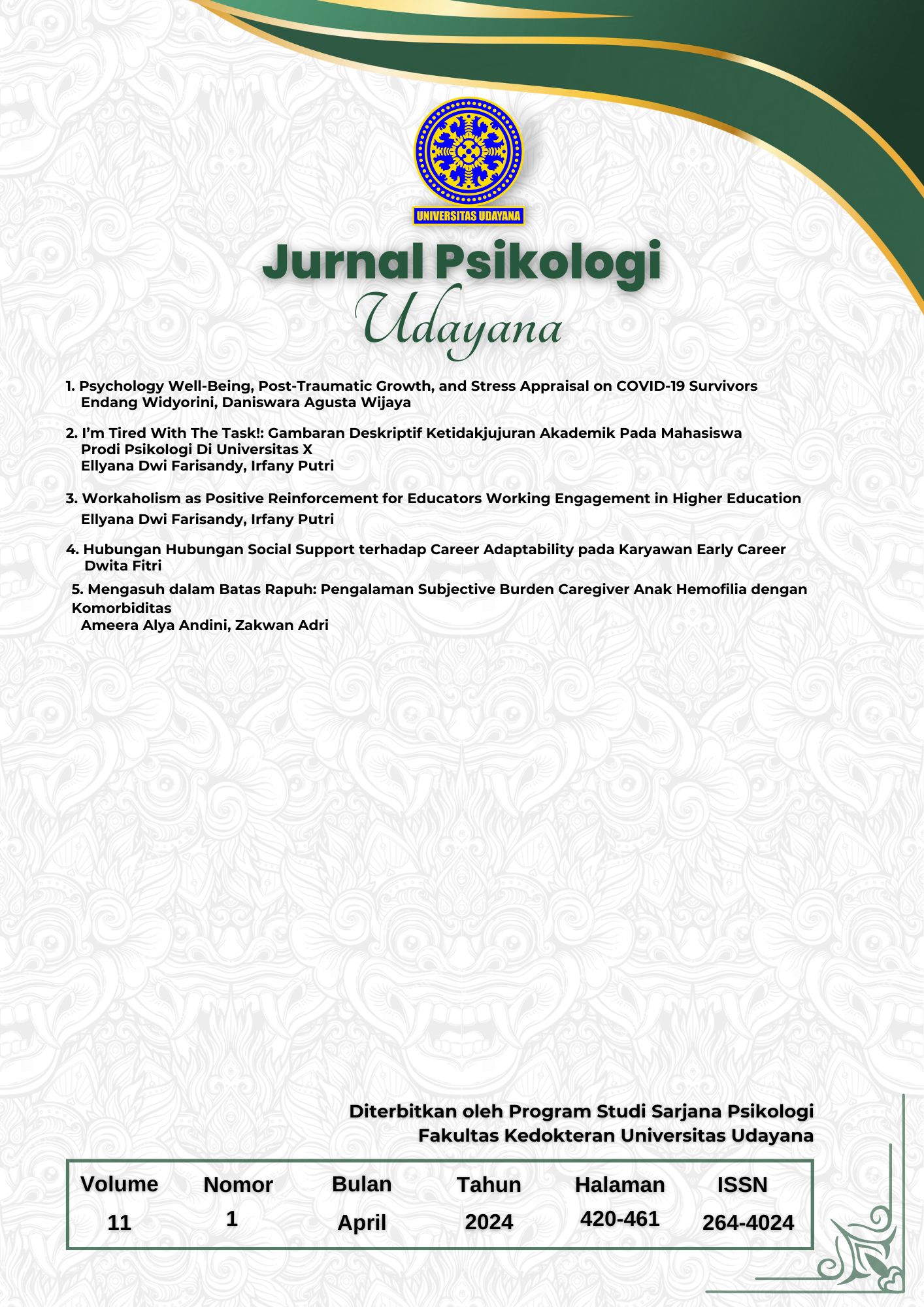
Workaholism as Positive Reinforcement for Educators Working Engagement in Higher Education
DOI:
https://doi.org/10.24843/JPU.2024.v11.i01.p03Abstract
Work engagement is an essential indicator for educators to be immersed in their work tasks and to ensure well-being at work. The various tasks and limited time given to educators, especially in higher education, can reduce work engagement. On the other hand, service industry organizations are experiencing a new behavioral phenomenon known as workaholism. This is characterized by employees’ habit of working excessively and compulsively. However, to our knowledge, no study has yet analyzed how workaholism in higher education correlates with educators’ working engagement. Therefore, this study aims to understand the effect and correlation between workaholism level and working engagement in higher education. The 41 lecturers from the Faculty of Industrial Technology at Universitas Atma Jaya Yogyakarta were asked to complete a questionnaire measuring workaholism level (DUWAS) and working engagement (UWES-9). The Pearson analysis of these two variables shows a moderate positive correlation (r = 0.565, p < .001). Moreover, the ANOVA analysis shows lecturers with workaholic behavior have significantly greater engagement levels (p < .05) than those without. This implies that a working environment should be created to promote healthy workaholism among higher education educators to maximize their engagement levels in their work.
Downloads
Published
Issue
Section
License
Copyright (c) 2026 Jurnal Psikologi Udayana

This work is licensed under a Creative Commons Attribution-ShareAlike 4.0 International License.
Authors who publish with this journal agree to the following terms:
- Authors retain copyright and grant the journal right of first publication with the work simultaneously licensed under a Creative Commons Attribution-ShareAlike 4.0 International License that allows others to share the work with an acknowledgement of the works authorship and initial publication in this journal.
- Authors are able to enter into separate, additional contractual arrangements for the non-exclusive distribution of the journals published version of the work (e.g., post it to an institutional repository or publish it in a book), with an acknowledgement of its initial publication in this journal.
- Authors are permitted and encouraged to post their work online (e.g., in institutional repositories or on their website) prior to and during the submission process, as it can lead to productive exchanges, as well as earlier and greater citation of published work (See The Effect of Open Access).