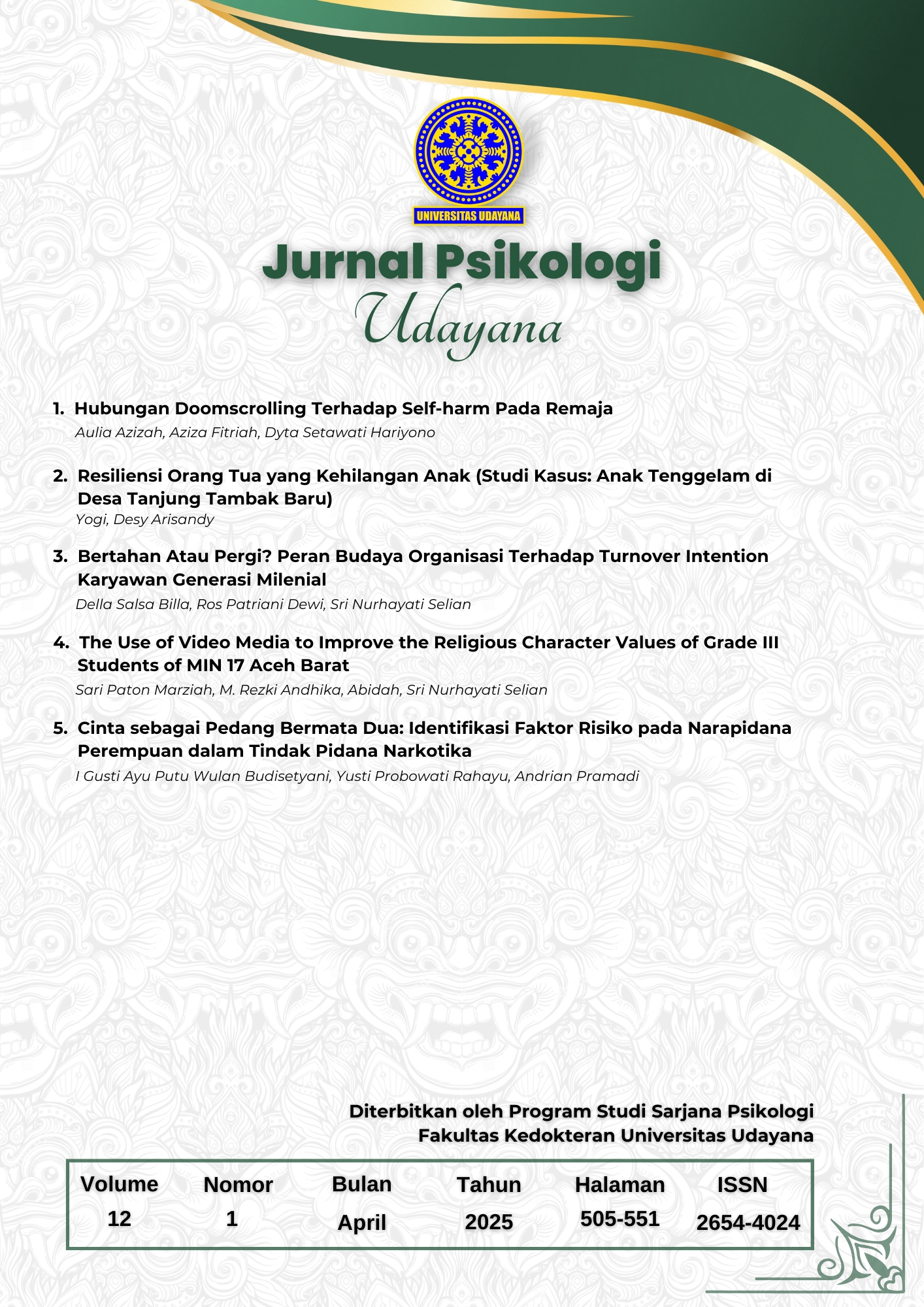
Parental Resilience Following the Loss Of a Child: A Case Study of a Child Drowning in Tanjung Tambak Baru Village
DOI:
https://doi.org/10.24843/JPU.2025.v12.i01.p02Keywords:
resilience, loss, drowningAbstract
This study examines the dynamics of parental resilience among individuals who have experienced the loss of a child due to drowning, a traumatic event that triggers profound grief and significant psychological distress. The main focus of this research is to understand how parents rebuild their resilience and to identify the internal and external factors that contribute to this process. This study addresses a gap in the literature, which has predominantly emphasized resilience among university students or disaster survivors, while parental resilience in the context of child loss, particularly in rural areas, remains relatively underexplored. This study employed a qualitative approach with a case study design and involved two participants from Tanjung Tambak Baru Village. Data were collected through in-depth interviews, observation, and documentation, and were analyzed using the interactive model of Miles and Huberman. The findings indicate that both participants experienced intense grief but followed different recovery pathways: one relied more on external support such as family and community, while the other drew on internal strengths including self-reflection, emotional regulation, and spirituality. Ultimately, both participants reached a stage of acceptance and were able to adapt to life after the loss of a child.
Downloads
Published
Issue
Section
License
Copyright (c) 2025 Jurnal Psikologi Udayana

This work is licensed under a Creative Commons Attribution-ShareAlike 4.0 International License.
Authors who publish with this journal agree to the following terms:
- Authors retain copyright and grant the journal right of first publication with the work simultaneously licensed under a Creative Commons Attribution-ShareAlike 4.0 International License that allows others to share the work with an acknowledgement of the works authorship and initial publication in this journal.
- Authors are able to enter into separate, additional contractual arrangements for the non-exclusive distribution of the journals published version of the work (e.g., post it to an institutional repository or publish it in a book), with an acknowledgement of its initial publication in this journal.
- Authors are permitted and encouraged to post their work online (e.g., in institutional repositories or on their website) prior to and during the submission process, as it can lead to productive exchanges, as well as earlier and greater citation of published work (See The Effect of Open Access).