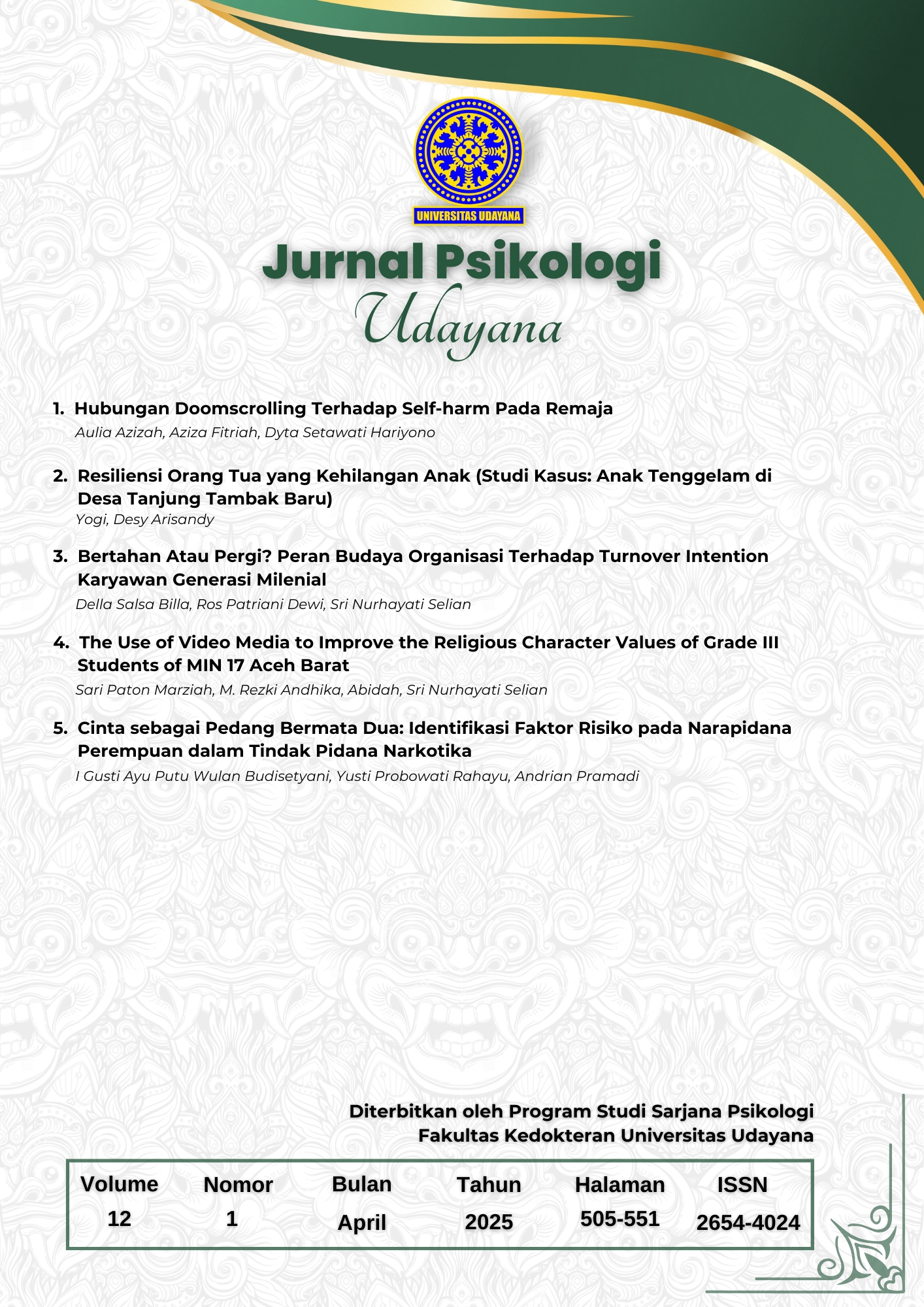
The relationship between doomscrolling and self-harm in adolescents
DOI:
https://doi.org/10.24843/JPU.2025.v12.i01.p01Keywords:
Adolescence, Doomscrolling, Self-harmAbstract
Self-harm is the act of intentionally harming oneself to express negative emotions in order to cope with emotional distress without the intention of committing suicide. The development of technology and social media has influenced the psychological development of adolescents. Doomscrolling is the compulsive and excessive consumption of negative news on social media. This study was conducted to investigate the relationship between Doomscrolling and Self-harmamong adolescents in Banjarmasin. The research method employed a quantitative approach with a correlational design. The research instruments used in this study were the Doomscrolling scale and the Self-harm Inventory. The sampling technique employed purposive sampling, with a sample size of 200 adolescent respondents aged 12–21 years in Banjarmasin. The results of the correlation test using Pearson’s r were 0.558 (ρ < 0.001), indicating a significant positive correlation between Doomscrolling and Self-harm among adolescents in Banjarmasin. It can be concluded that Doomscrolling has the potential to be a risk factor for increasing selfharm. This study is expected to enrich empirical references and serve as a basis for further research.
Downloads
Published
Issue
Section
License
Copyright (c) 2025 Jurnal Psikologi Udayana

This work is licensed under a Creative Commons Attribution-ShareAlike 4.0 International License.
Authors who publish with this journal agree to the following terms:
- Authors retain copyright and grant the journal right of first publication with the work simultaneously licensed under a Creative Commons Attribution-ShareAlike 4.0 International License that allows others to share the work with an acknowledgement of the works authorship and initial publication in this journal.
- Authors are able to enter into separate, additional contractual arrangements for the non-exclusive distribution of the journals published version of the work (e.g., post it to an institutional repository or publish it in a book), with an acknowledgement of its initial publication in this journal.
- Authors are permitted and encouraged to post their work online (e.g., in institutional repositories or on their website) prior to and during the submission process, as it can lead to productive exchanges, as well as earlier and greater citation of published work (See The Effect of Open Access).