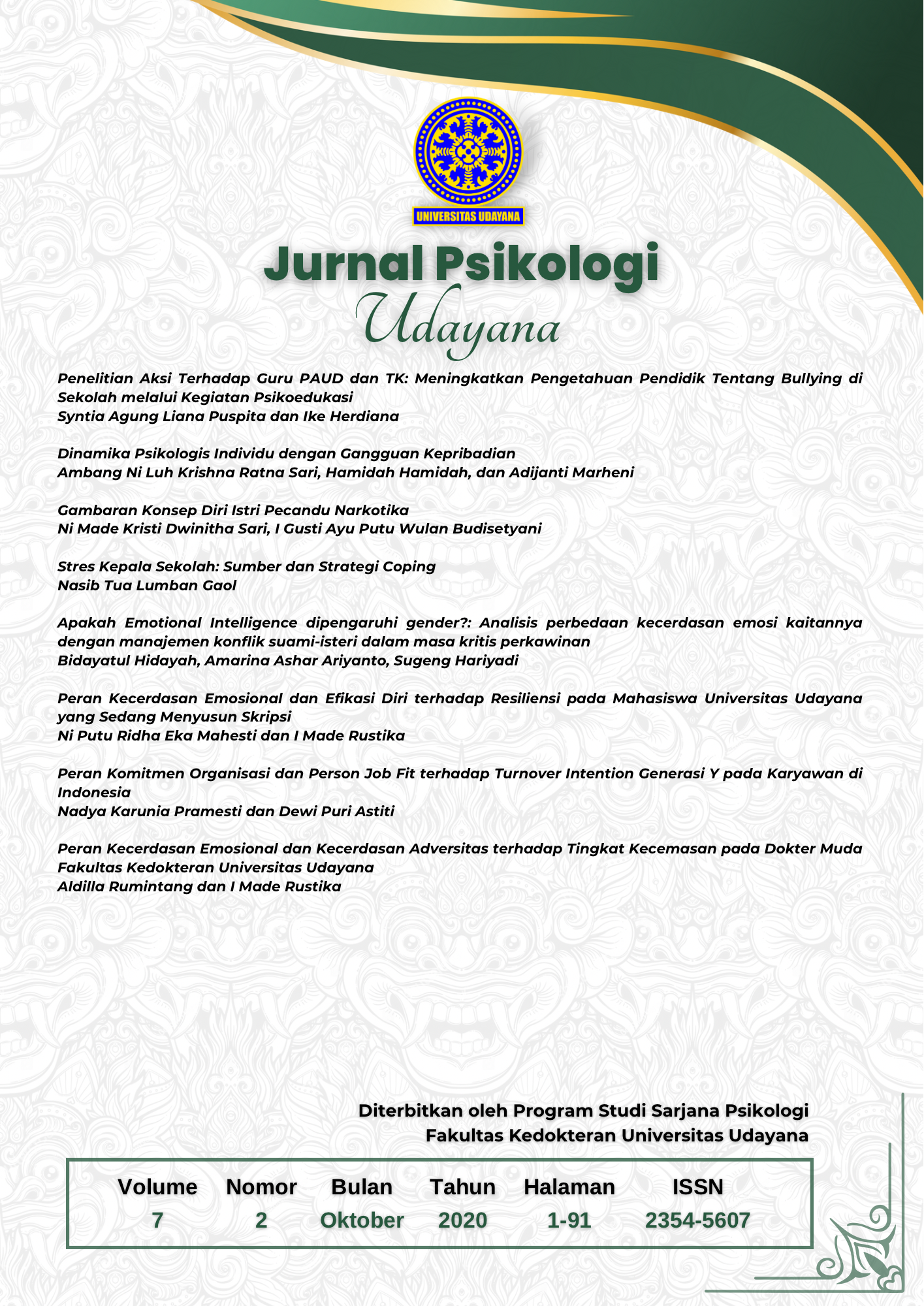
Peranan komitmen organisasi dan person job fit terhadap turnover intentiongenerasi Y pada karyawan di Indonesia
DOI:
https://doi.org/10.24843/JPU.2020.v07.i02.p07Abstrak
Sejumlah riset terdahulu sudah memperlihatkan bahwa Generasi Y mempunyai nilai turnover yang lebih tinggi dibandingkan generasi lainnya. Pergantian karyawan didahului oleh niat untuk berubah. Nilai niat turnamen pada karyawan yang dipengaruhi oleh komitmen organisasi, dan pekerjaan membutuhkan mereka.Riset ini ialah pendekatan kuantitatif yang bertujuan untuk menentukan peranan komitmen organisasi dan bekerja bersama mereka sesegera tujuan turnamen untuk karyawan gen-Y diIndonesia. Subjek terkait dengan riset ialah 176 karyawan Y generasi di Indonesia. Alat pengukuran diterapkan ialah skala komitmen organisasi, skala pekerjaan dan skala skala turnamen. Temuan uji regresi berganda memperlihatkan koefisien regresssion sejumlah 0,598, koefisien determinan 0,357 dan nilai signifikansi 0,000 (p <0,05) dengan koefisien beta (standardize) pada variabel komitmen organisasi -0,434 serta proyek work fit dari variabel 0,259.
Unduhan
Diterbitkan
Terbitan
Bagian
Lisensi
Hak Cipta (c) 2026 Jurnal Psikologi Udayana

Artikel ini berlisensiCreative Commons Attribution-ShareAlike 4.0 International License.
Authors who publish with this journal agree to the following terms:
- Authors retain copyright and grant the journal right of first publication with the work simultaneously licensed under a Creative Commons Attribution-ShareAlike 4.0 International License that allows others to share the work with an acknowledgement of the works authorship and initial publication in this journal.
- Authors are able to enter into separate, additional contractual arrangements for the non-exclusive distribution of the journals published version of the work (e.g., post it to an institutional repository or publish it in a book), with an acknowledgement of its initial publication in this journal.
- Authors are permitted and encouraged to post their work online (e.g., in institutional repositories or on their website) prior to and during the submission process, as it can lead to productive exchanges, as well as earlier and greater citation of published work (See The Effect of Open Access).