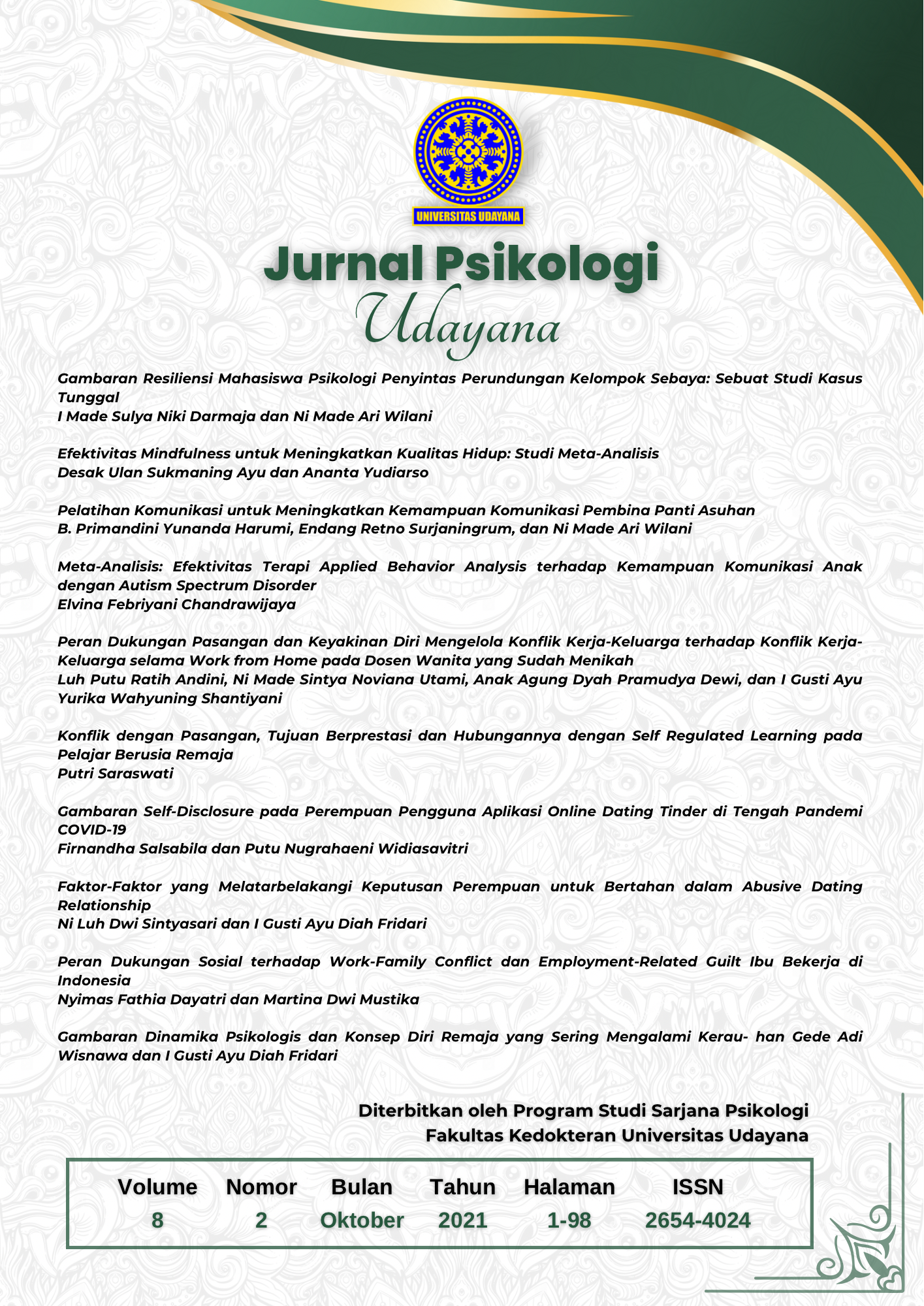
Konflik dengan pasangan, tujuan berprestasi, dan hubungannya dengan self-regulated learning pada pelajar berusia remaja
DOI:
https://doi.org/10.24843/JPU.2021.v08.i02.p06Abstrak
Teens begin to be attracted to the opposite sex, some even have romantic relationships with the opposite sex. In relation to other people, it is very possible to cause conflict. Differences experienced by two people (pairs) can cause interference in learning, especially if the person does not have a clear achievement goal in learning. This study aims to determine the relationship between the ability of adolescents in overcoming conflicts with partners, achieving goals, and independent learning. The subjects of this study were 388 high school students, 182 male students and 206 female students. The sampling used is cluster random sampling. The data was taken in the city of Malang and the Likert scale is a measuring tool used for the third variable. The results of this study indicate that 1) there is no relationship between romantic partner conflict and SRL (r=0.48, sig=0.344<0.05); 2) however, achievement goal is not a mediating for romantic partner conflict variable and SRL; 3) there is a positive relationship between romantic partner conflict and the achievement goal (r = 0.122, sig = 0.016).
Unduhan
Diterbitkan
Terbitan
Bagian
Lisensi
Hak Cipta (c) 2026 Jurnal Psikologi Udayana

Artikel ini berlisensiCreative Commons Attribution-ShareAlike 4.0 International License.
Authors who publish with this journal agree to the following terms:
- Authors retain copyright and grant the journal right of first publication with the work simultaneously licensed under a Creative Commons Attribution-ShareAlike 4.0 International License that allows others to share the work with an acknowledgement of the works authorship and initial publication in this journal.
- Authors are able to enter into separate, additional contractual arrangements for the non-exclusive distribution of the journals published version of the work (e.g., post it to an institutional repository or publish it in a book), with an acknowledgement of its initial publication in this journal.
- Authors are permitted and encouraged to post their work online (e.g., in institutional repositories or on their website) prior to and during the submission process, as it can lead to productive exchanges, as well as earlier and greater citation of published work (See The Effect of Open Access).