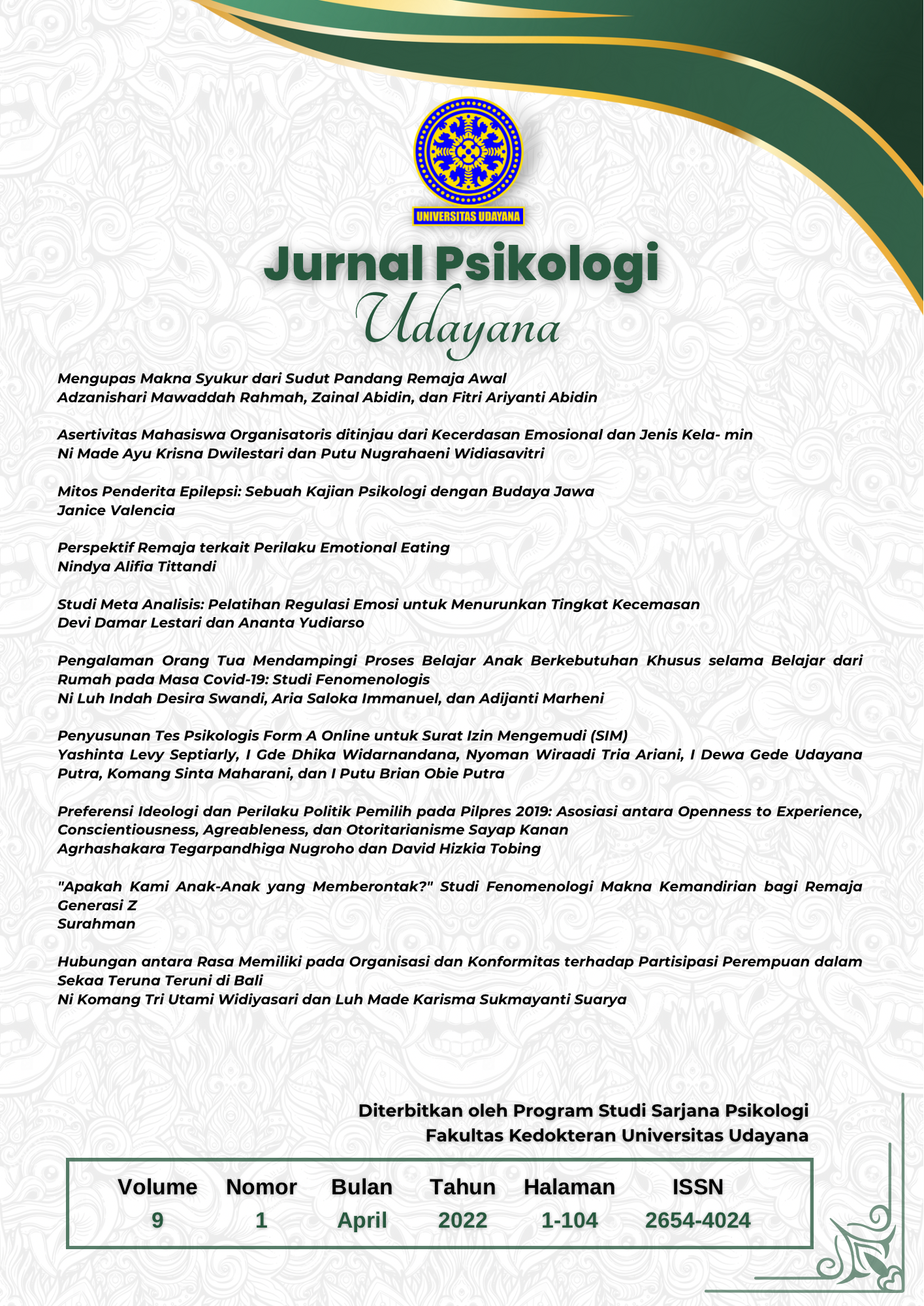
Mitos penderita epilepsi: Sebuah kajian psikologi dengan budaya Jawa
DOI:
https://doi.org/10.24843/JPU.2022.v09.i01.p03Abstrak
Epilepsy which is known as "epileptic" disease has become controversial in Indonesia. Epilepsy in Indonesia is considered as a cursed person, a cursed child, the sins of the ancestors, and also possessed by spirits. Epilepsy is also still considered as an infectious disease and also mental illness. This makes a negative stigma against people with epilepsy and also affects the families of epilepsy sufferers. The purpose of this article is to provide a study of the myths of epilepsy sufferers from the perspective of cultural psychology. This study is expected to explain the myths of epilepsy sufferers so that there is no negative stigma against epilepsy sufferers. The myth of epilepsy is in the community because of sudden seizures, sufferers struggling, foaming at the mouth for a few minutes and then returning to normal, this is perceived as being possessed by a spirit that is in accordance with the culture of "kejawen" which is then used by some people to become a supernatural science " witchcraft "so that eventually people with epilepsy are considered as possessed by spirits. With the negative stigma towards epilepsy, Indonesia, which has a high collective culture, causes families of epileptic sufferers to try to hide illnesses from sufferers to protect, maintain the harmony of all family members. Referring to the literature, psychological approaches can be applied in the development and understanding of the myths of epileptic sufferers.
Unduhan
Diterbitkan
Terbitan
Bagian
Lisensi
Hak Cipta (c) 2026 Jurnal Psikologi Udayana

Artikel ini berlisensiCreative Commons Attribution-ShareAlike 4.0 International License.
Authors who publish with this journal agree to the following terms:
- Authors retain copyright and grant the journal right of first publication with the work simultaneously licensed under a Creative Commons Attribution-ShareAlike 4.0 International License that allows others to share the work with an acknowledgement of the works authorship and initial publication in this journal.
- Authors are able to enter into separate, additional contractual arrangements for the non-exclusive distribution of the journals published version of the work (e.g., post it to an institutional repository or publish it in a book), with an acknowledgement of its initial publication in this journal.
- Authors are permitted and encouraged to post their work online (e.g., in institutional repositories or on their website) prior to and during the submission process, as it can lead to productive exchanges, as well as earlier and greater citation of published work (See The Effect of Open Access).