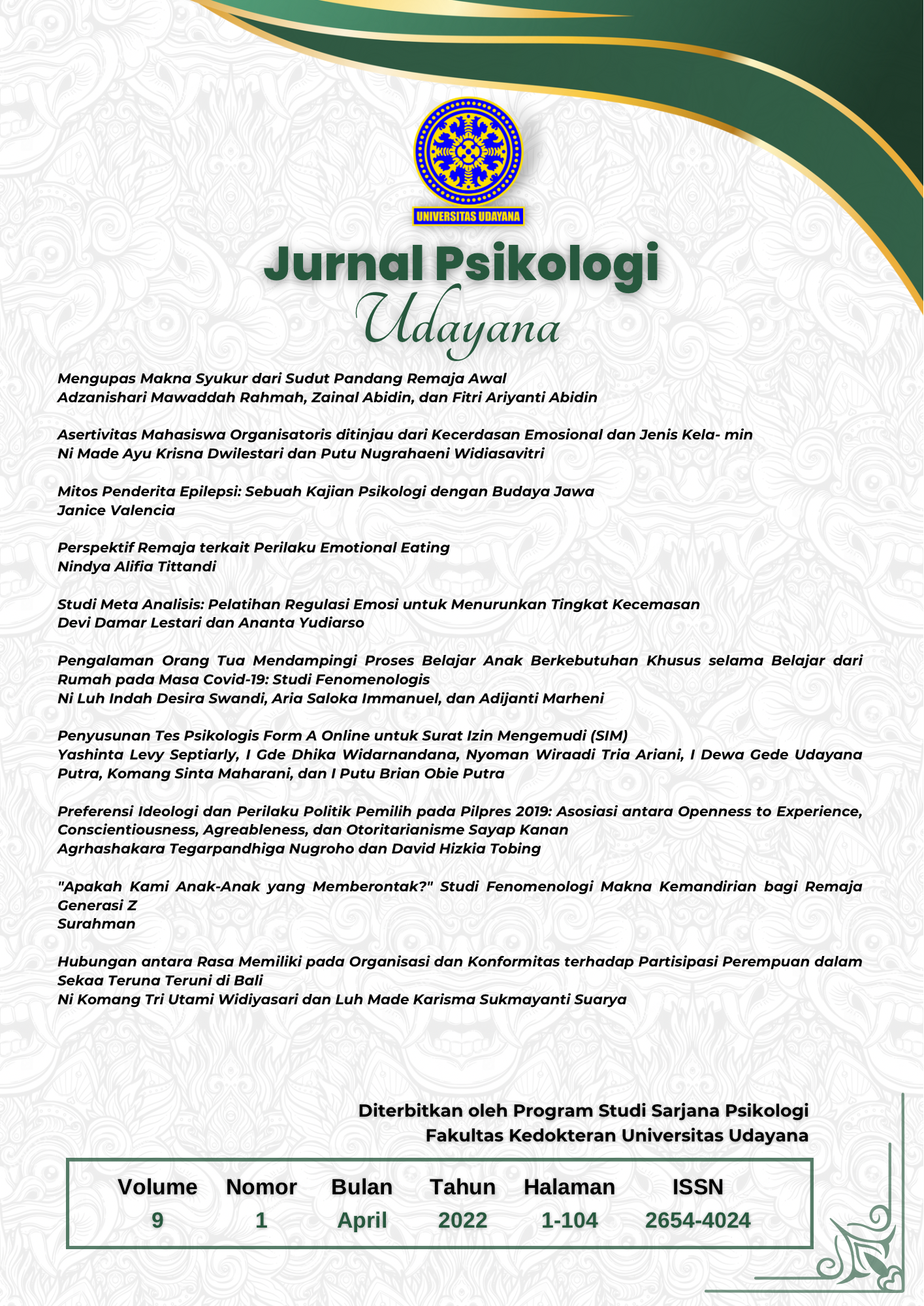
“Apakah kami anak-anak yang memberontak?” Studi fenomenologi makna kemandirian bagi remaja generasi Z
DOI:
https://doi.org/10.24843/JPU.2022.v09.i01.p09Abstrak
Generation Z adolescents as a group of individuals who know internet technology from an early age have a different autonomy from the previous generations. The autonomy experienced by generation Z adolescents is followed by behavior that is difficult to understand and sometimes misinterpreted as rebellion, for example disagreeing with their parents and doing things without the help of their parents anymore. Based on this phenomenon, this study aims to analyze the meaning of autonomy for generation Z adolescents. This study uses a qualitative approach with phenomenological methods. Data were collected using semi-structured interviews and then analyzed using the Interpretative Phenomenological Analysis (IPA) technique on four adolescents (19-21 years). Based on the results of the analysis obtained the meaning of independence for generation Z adolescents, namely: (1) efforts to reduce intervention / assistance from parents; (2) differing views with parents; (3) accept the opportunity of parents to make decisions; and (4) the initiative to build work experience.
Unduhan
Diterbitkan
Terbitan
Bagian
Lisensi
Hak Cipta (c) 2026 Jurnal Psikologi Udayana

Artikel ini berlisensiCreative Commons Attribution-ShareAlike 4.0 International License.
Authors who publish with this journal agree to the following terms:
- Authors retain copyright and grant the journal right of first publication with the work simultaneously licensed under a Creative Commons Attribution-ShareAlike 4.0 International License that allows others to share the work with an acknowledgement of the works authorship and initial publication in this journal.
- Authors are able to enter into separate, additional contractual arrangements for the non-exclusive distribution of the journals published version of the work (e.g., post it to an institutional repository or publish it in a book), with an acknowledgement of its initial publication in this journal.
- Authors are permitted and encouraged to post their work online (e.g., in institutional repositories or on their website) prior to and during the submission process, as it can lead to productive exchanges, as well as earlier and greater citation of published work (See The Effect of Open Access).