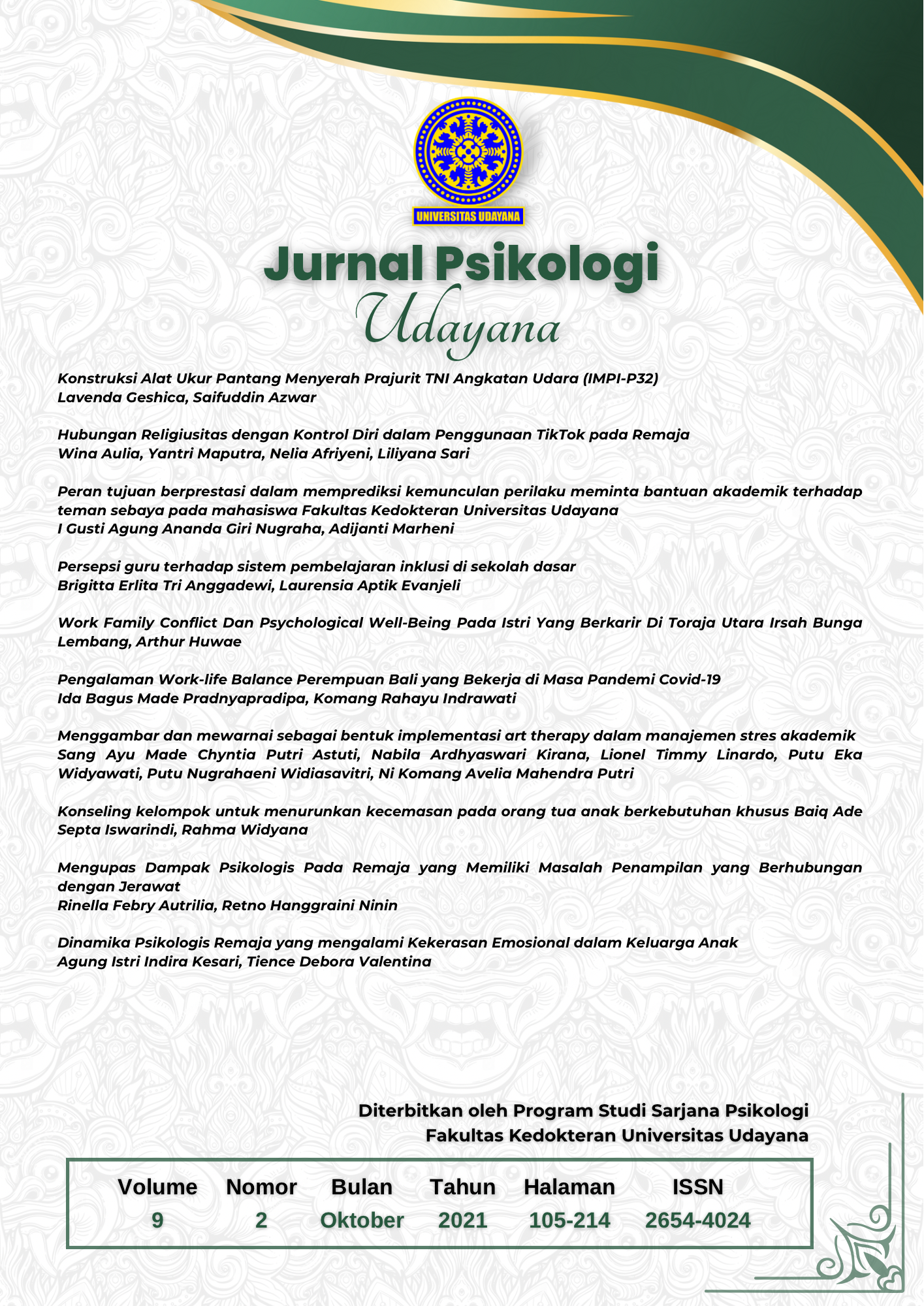
Hubungan Religiusitas dengan Kontrol Diri dalam Penggunaan TikTok pada Remaja
DOI:
https://doi.org/10.24843/JPU.2022.v09.i02.p10Abstrak
The use of the TikTok is currently dominated by adolescents. Adolescents attempt to look as attractive as possible in TikTok without even considering the negative consequences of their actions. Self-control of adolescents can minimize the negative impacts of using TikTok. Self-control in using TikTok among adolescents can be obtained from guidelines in the form of values, one of which is the value of religion or religiosity. This study aimed to examine the relationship between religiosity and self-control in using TikTok among adolescents. The method used in this study was quantitative with 150 subjects aged 11-17 years who uploaded videos on TikTok. The instruments were the Self-Control in Using TikTok Scale and the Centrality of Religiosity Scale (CRS-15). The Spearman's Rank correlation test results showed that there was a positive relationship between religiosity and self-control in using TikTok for adolescents (r=0.162; p=0.048). The results indicated that higher religiosity is associated with higher self-control in using TikTok among adolescents, and the lower the religiosity, the lower the self-control in the use of TikTok in adolescents. In addition, most adolescents in the study were reported to have a high level of religiosity whereas moderate level of self-control in the use of Tiktok.
Unduhan
Diterbitkan
Terbitan
Bagian
Lisensi
Hak Cipta (c) 2026 Jurnal Psikologi Udayana

Artikel ini berlisensiCreative Commons Attribution-ShareAlike 4.0 International License.
Authors who publish with this journal agree to the following terms:
- Authors retain copyright and grant the journal right of first publication with the work simultaneously licensed under a Creative Commons Attribution-ShareAlike 4.0 International License that allows others to share the work with an acknowledgement of the works authorship and initial publication in this journal.
- Authors are able to enter into separate, additional contractual arrangements for the non-exclusive distribution of the journals published version of the work (e.g., post it to an institutional repository or publish it in a book), with an acknowledgement of its initial publication in this journal.
- Authors are permitted and encouraged to post their work online (e.g., in institutional repositories or on their website) prior to and during the submission process, as it can lead to productive exchanges, as well as earlier and greater citation of published work (See The Effect of Open Access).