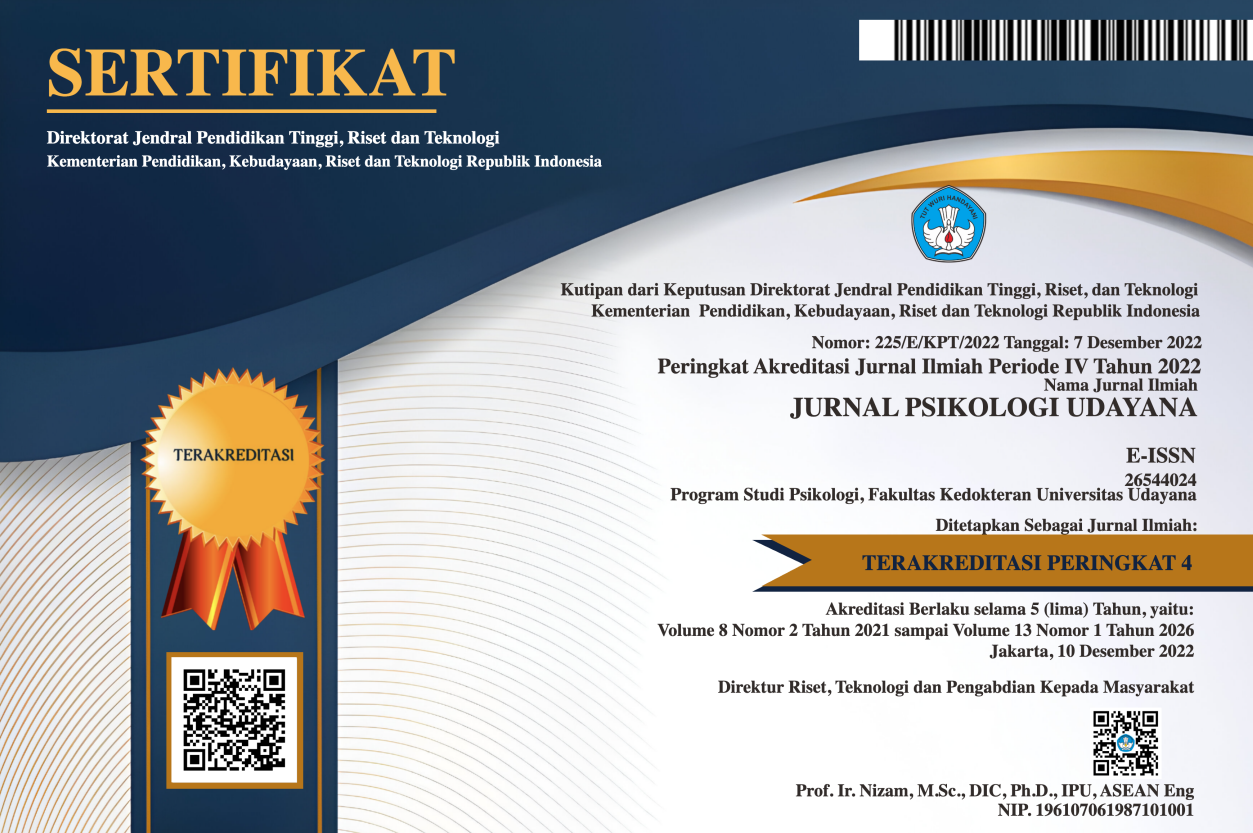
I’m Tired With The Task!: Gambaran Deskriptif Ketidakjujuran Akademik Pada Mahasiswa Prodi Psikologi Di Universitas X
DOI:
https://doi.org/10.24843/JPU.2024.v11.i01.p02Abstrak
This study aims to explore academic dishonesty in undergraduate students of Psychology Study Program at University X. The design used is a descriptive study. Sample technique using conventional sampling with a total of 182 undergraduate students of Psychology Study Program at University X. The measuring instrument used is the Academic Dishonesty (ADS) which was compiled by Ampuni et al. (2019) based on measurements of academic dishonesty from McCabe and Trevino (1993) and Stone et al. (2010). The results show that there are some undergraduate students who still practice academic dishonesty, like cheating, unauthorized collaboration, and plagiarism. Besides that, the tendency for academic dishonesty to be committed in undergraduate students of Psychology Study Program at University X is in the very high category when viewed from group norms. The majority of factors that cause undergraduate students to commit academic dishonesty come from internal factors, namely wanting to get higher grades and external factors, namely the existence of lecturers who give many assignments.
Unduhan
Diterbitkan
Terbitan
Bagian
Lisensi
Hak Cipta (c) 2026 Jurnal Psikologi Udayana

Artikel ini berlisensiCreative Commons Attribution-ShareAlike 4.0 International License.
Authors who publish with this journal agree to the following terms:
- Authors retain copyright and grant the journal right of first publication with the work simultaneously licensed under a Creative Commons Attribution-ShareAlike 4.0 International License that allows others to share the work with an acknowledgement of the works authorship and initial publication in this journal.
- Authors are able to enter into separate, additional contractual arrangements for the non-exclusive distribution of the journals published version of the work (e.g., post it to an institutional repository or publish it in a book), with an acknowledgement of its initial publication in this journal.
- Authors are permitted and encouraged to post their work online (e.g., in institutional repositories or on their website) prior to and during the submission process, as it can lead to productive exchanges, as well as earlier and greater citation of published work (See The Effect of Open Access).