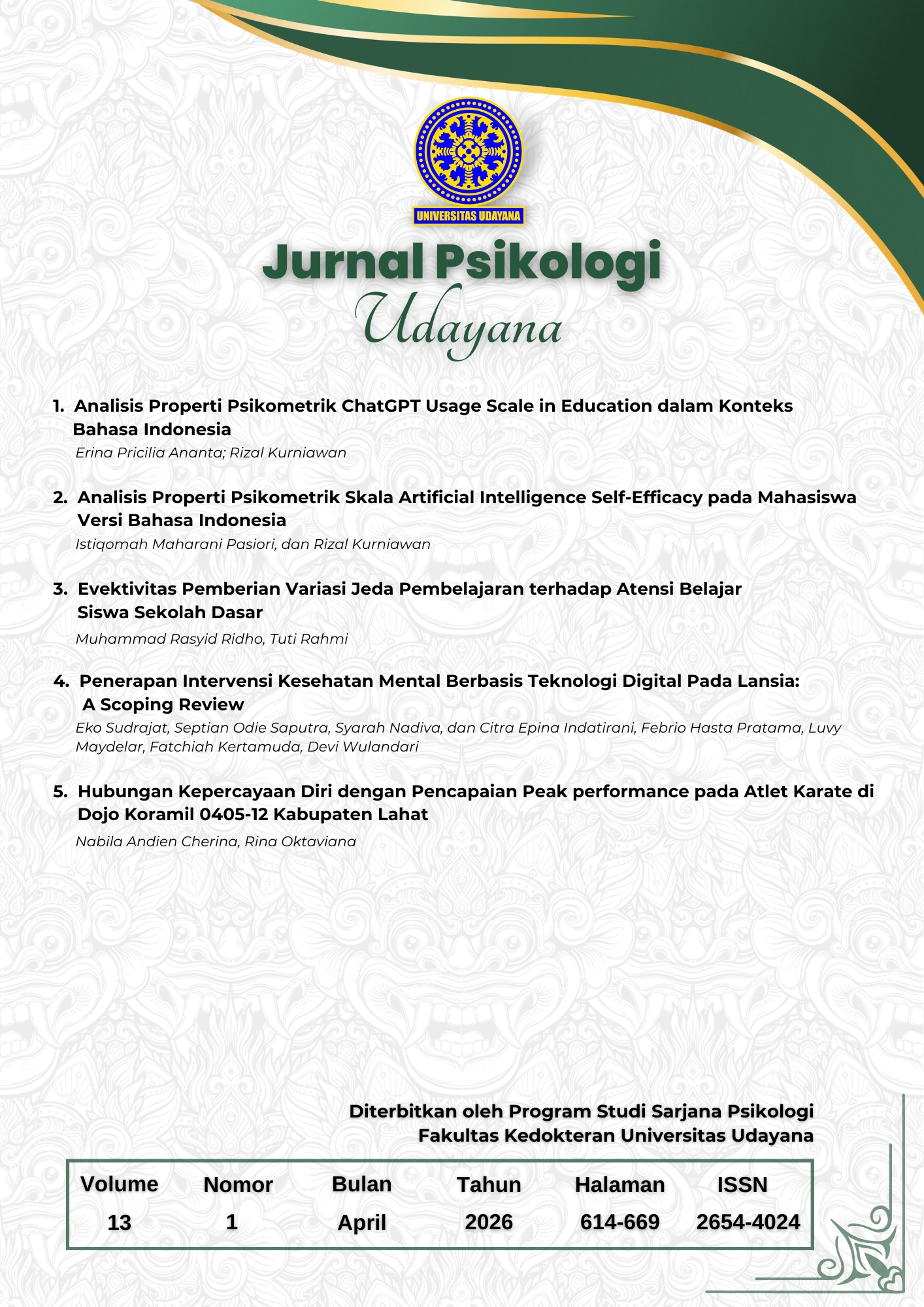
Analisis Properti Psikometrik Skala Artificial Intelligence Self-Efficacy pada Mahasiswa Versi Bahasa Indonesia
DOI:
https://doi.org/10.24843/JPU.2026.v13.i01.p02Kata Kunci:
Artificial Intelligence, Psikometrik, Self-EfficacyAbstrak
Penelitian ini bertujuan untuk menganalisis properti psikometrik Artificial Intelligence Self-Efficacy Scale (AISES) versi bahasa Indonesia pada mahasiswa. Adaptasi mengacu pada panduan International Test Commission (2017) dan validitas isi dianalisis menggunakan metode Aiken’s V untuk memastikan kesesuaian konsep dan makna. Penelitian ini melibatkan 560 mahasiswa di Indonesia sebagai subjek dengan pemilihan sampel menggunakan teknik non-probablility sampling berupa purposive sampling. Penelitian ini berhasil mengonfirmasi struktur internal AISES menggunakan Exploratory Factor Analysis (EFA) dan Confirmatory Factor Analysis (CFA) yang terdiri dari empat dimensi, yaitu Assistance, Anthropomorphic Interaction, Comfort with AI, dan Technological Skills dengan indeks fit model yang baik (CFI = 0.914, TLI = 0.902, RMSEA = 0.061, SRMR = 0.063). Meskipun menghapus satu item pada dimensi Technological Skills, AISES versi Indonesia ini memiliki koefisien reliabilitas yang cukup tinggi dengan Cronbach’s α = 0.908 dan McDonald’s ω = 0.916. Hasil menunjukkan bahwa AISES versi bahasa Indonesia adalah instrumen yang valid dan memadai untuk mengukur self-efficacy terhadap AI pada populasi mahasiswa.
Unduhan
Diterbitkan
Terbitan
Bagian
Lisensi
Hak Cipta (c) 2026 Jurnal Psikologi Udayana

Artikel ini berlisensiCreative Commons Attribution-ShareAlike 4.0 International License.
Authors who publish with this journal agree to the following terms:
- Authors retain copyright and grant the journal right of first publication with the work simultaneously licensed under a Creative Commons Attribution-ShareAlike 4.0 International License that allows others to share the work with an acknowledgement of the works authorship and initial publication in this journal.
- Authors are able to enter into separate, additional contractual arrangements for the non-exclusive distribution of the journals published version of the work (e.g., post it to an institutional repository or publish it in a book), with an acknowledgement of its initial publication in this journal.
- Authors are permitted and encouraged to post their work online (e.g., in institutional repositories or on their website) prior to and during the submission process, as it can lead to productive exchanges, as well as earlier and greater citation of published work (See The Effect of Open Access).