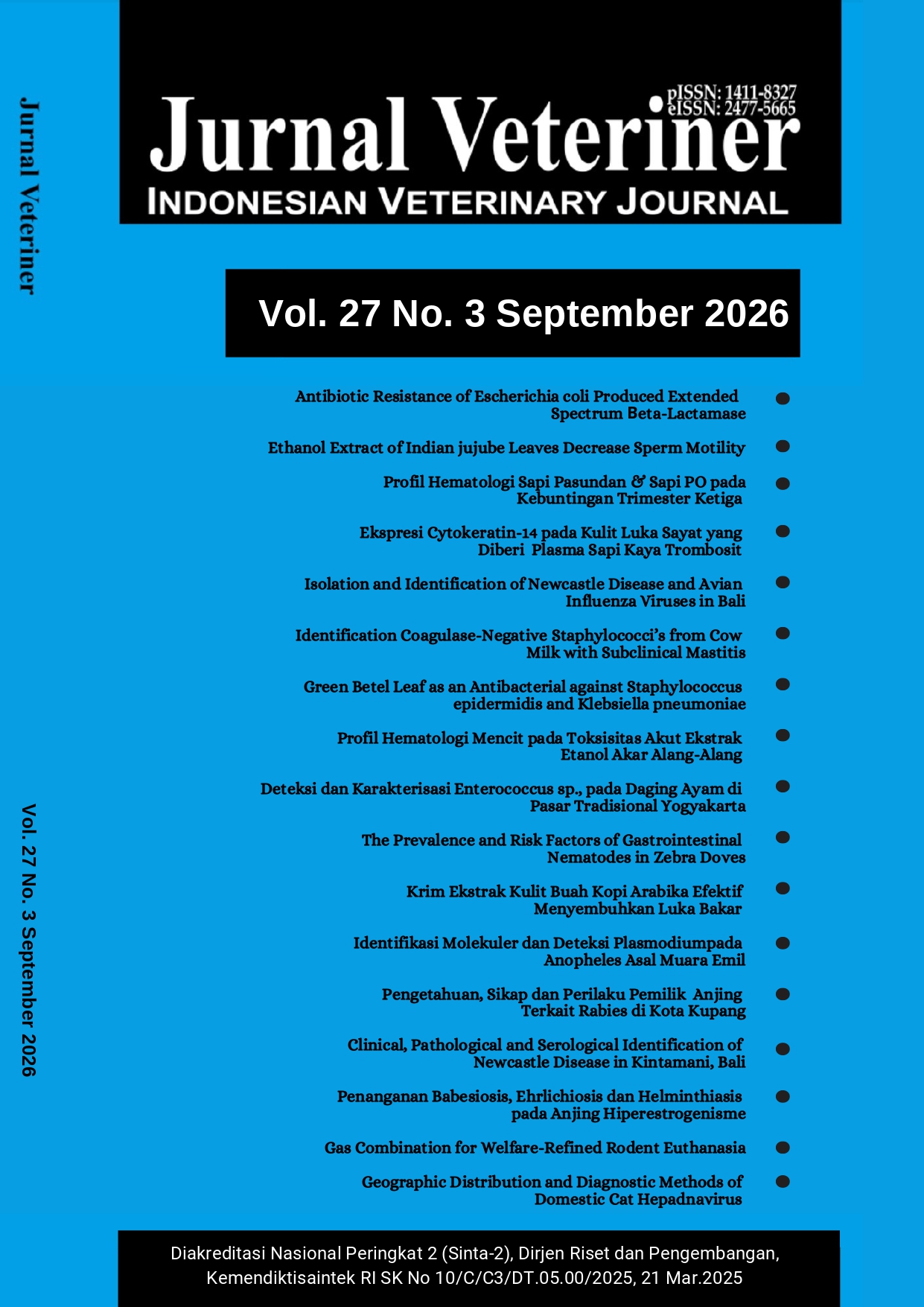
The Prevalence and Risk Factors of Gastrointestinal Nematodes in Zebra Doves (Geopelia striata) Sold in Denpasar City
Keywords:
Denpasar City, Geopelia striata or Zebra Dove, gastrointestinal nematodes, risk factorsAbstract
ABSTRACT
The Zebra Dove (Geopelia striata) is a songbird commonly traded in Denpasar, Bali. The husbandry system and environmental conditions during the trading process have the potential to increase the risk of parasitic infections, including gastrointestinal nematodes. This study was aimed to identify the types of gastrointestinal nematodes, determine the prevalence of infection and analyze the risk factors associated with infection in Zebra Doves traded in Denpasar City. An observational study with a cross-sectional design was conducted. A total of 61 fecal samples were collected from markets and bird shops in four districts of Denpasar City and examined using direct smear and flotation methods. Parasites were identified microscopically based on morphology and morphometry using ImageJ software. Risk factor analysis was performed using the Chi-square test and Odds Ratio (OR) calculations. The results showed a prevalence of gastrointestinal nematode infection in Zebra Dove was 22.95% (14/61). In this study three genera of nematodes were identified including Heterakis spp., (16.39%), Ascaridia spp., (8.20%) and Trichostrongylus spp., (6.56%), occurring as both single and mixed infections. Statistical analysis showed that feed type was significantly associated (p < 0.05) with the prevalence of infection. Zebra Doves fed with commercial feed had a 3.488 times more like;y to cause gastrointestinal nematode infection than those fed natural feed. In contrast, the maintenance system, age, administration of anthelmintic treatment, frequency of drinking water containers cleaning, and source of bird acquisition showed no significant associations. In conclusion, the prevalence of gastrointestinal nematode infection in Zebra Doves in Denpasar City was moderate and was influenced by dietary factors.
Downloads
Published
Issue
Section
License
Copyright (c) 2026 Suci Ramadhani, Ida Ayu Pasti Apsari, I Putu Cahyadi Putra (Author)

This work is licensed under a Creative Commons Attribution 4.0 International License.
License Terms
This journal applies the terms of the Creative Commons Attribution 4.0 International License (CC BY 4.0).
Under this license, authors retain copyright and grant the journal the right of first publication. The published articles are freely available and can be:
-
Shared – copied and redistributed in any medium or format.
-
Adapted – remixed, transformed, and built upon for any purpose, even commercially.
Conditions:
-
Attribution – Appropriate credit must be given to the original author(s) and the source (the journal), a link to the license must be provided, and indication of any changes made must be included.
-
No additional restrictions – The licensor cannot apply legal terms or technological measures that legally restrict others from doing anything the license permits.
By submitting and publishing in this journal, authors agree to make their work available under the CC BY 4.0 License.
For more details, please visit: https://creativecommons.org/licenses/by/4.0/