
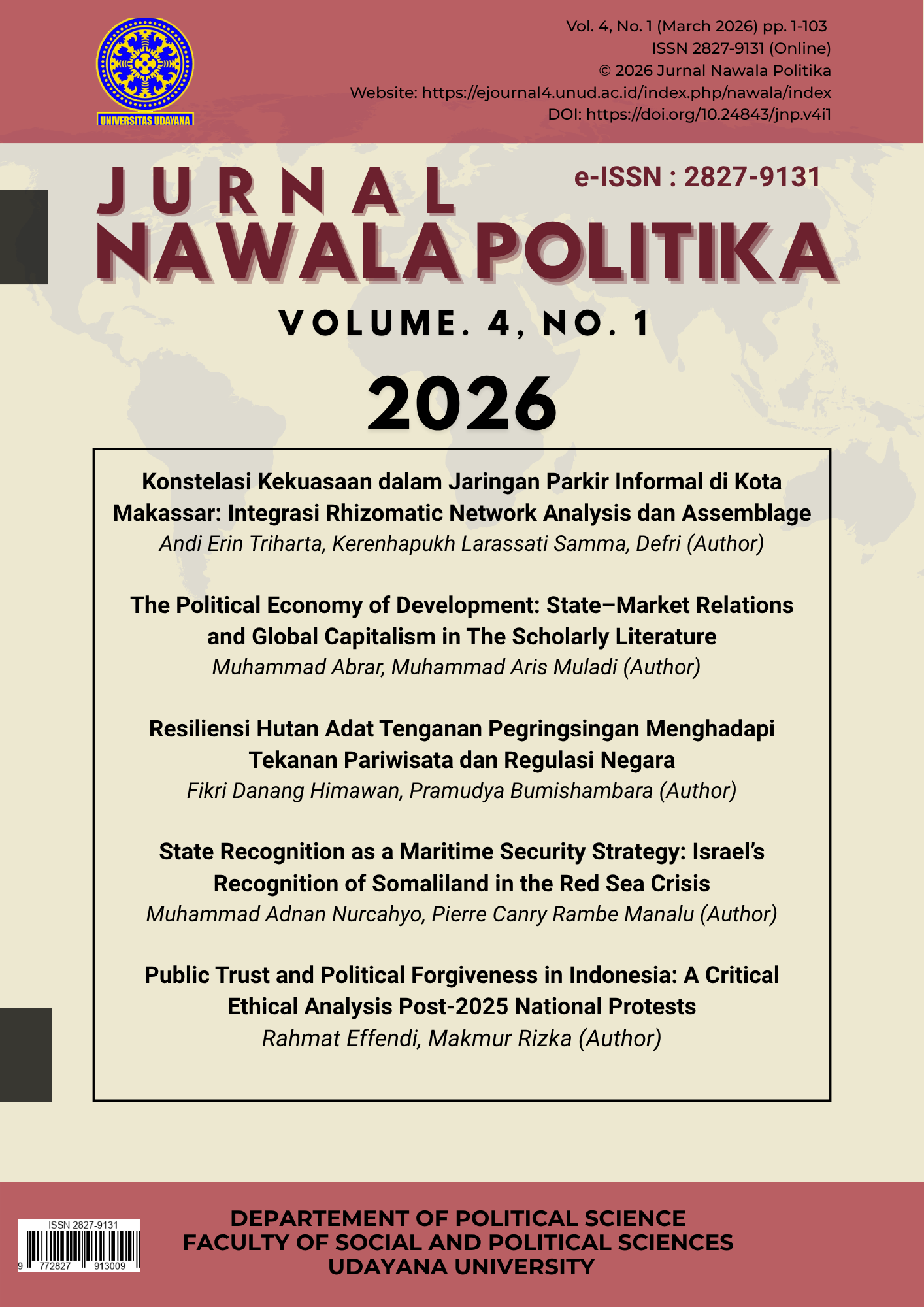
Resiliensi Hutan Adat Tenganan Pegringsingan Menghadapi Tekanan Pariwisata dan Regulasi Negara
DOI:
https://doi.org/10.24843/jnp.v4i1.2220Keywords:
Customary Forest, Political Economy, Social ResilienceAbstract
This study analyzes the resilience of Tenganan Pegringsingan Customary Forest against tourism pressure and state regulation. Synthesizing Traditional Ecological Knowledge (TEK), Social Capital, and Ostrom’s Institutional Design, this research employs a qualitative case study to examine the causal-institutional dynamics of resource management. The findings reveal a paradoxical condition: the forest management is internally optimal, supported by high biodiversity and strict customary laws (awig-awig), yet externally vulnerable to legal fragmentation and market commodification. State interventions often create legitimacy crises, while global ecotourism risks eroding sacred values. The study concludes that sustainability requires a "nested enterprises" model in which indigenous institutions are recognized as equal partners in governance. Furthermore, contextual education is essential to prevent the erosion of TEK among the younger generation, ensuring the long-term preservation of this social-ecological system.
Downloads
References
Abioso, W. S., & Triyadi, S. (2018). Quality of common space in traditional residential area in perspective of use satisfaction. IOP Conference Series: Materials Science and Engineering, 407, 012072. https://doi.org/10.1088/1757-899X/407/1/012072
Agrawal, A., & Gibson, C. C. (1999). Enchantment and disenchantment: The role of community in natural resource conservation. World Development, 27(4), 629–649. https://doi.org/10.1016/S0305-750X(98)00161-2
Aldyan, A., Aldyan, R. A., Asmanda, K. A. P., & Alasttal, A. A. (2025). Legal pluralism in environmental management: Evidence from Bali, Indonesia. Journal of Law, Environmental and Justice, 3(2), 229–267. https://doi.org/10.62264/jlej.v3i2.131
Astawa, I. G., Budiarsa, M., & Simpen, I. W. (2019). The representation of the Tri Hita Karana ecosophy in the awig-awig (customary law) text of Tenganan Pegringsingan village: A critical ecolinguistics perspective. Journal of Language Teaching and Research, 10(2), 396–401. http://dx.doi.org/10.17507/jltr.1002.23
Astiti, N. K. D. M., & Sugiantari, A. A. P. W. (2023). Efektivitas awig-awig dalam kelestarian lingkungan hidup pohon di Desa Adat Tenganan Pegringsingan, Kecamatan Manggis, Kabupaten Karangasem. Jurnal Hukum Mahasiswa, 3(1), 656–669. https://doi.org/10.36733/jhm.v1i2
Berkes, F., Colding, J., & Folke, C. (2000). Rediscovery of traditional ecological knowledge as adaptive management. Ecological Applications, 10(5), 1251–1262. https://doi.org/10.1890/1051-0761(2000)010[1251:ROTEKA]2.0.CO;2
Coleman, J. S. (1988). Social capital in the creation of human capital. American Journal of Sociology, 94(Suppl.), S95–S120. https://doi.org/10.1086/228943
Febriani, L., & Lokantara, I. G. W. (2017). Community participation towards the value of traditional architecture resilience on the settlements' patterns in Tenganan Pegringsingan village, Amlapura. IOP Conference Series: Earth and Environmental Science, 99, 012018. https://doi.org/10.1088/1755-1315/99/1/012018
Kridasakti, S. W., Rizkiana, R. E., Wahyuni, P. M., Senastri, N. M. J., & Yuningsih, H. (2025). The legitimacy crisis of customary villages under Indonesia's Village Law. Sriwijaya Law Review, 9(2), 432–456. https://doi.org/10.28946/slrev.v9i2.3998
Lestawi, I. N., & Bunga, D. (2020). The role of customary law in the forest preservation in Bali. Journal of Landscape Ecology, 13(1), 25–41. https://doi.org/10.2478/jlecol-2020-0002
Li, T. M. (2001). Masyarakat adat, difference, and the limits of recognition in Indonesia's forest zone. Modern Asian Studies, 35(3), 645–676. https://doi.org/10.1017/S0026749X01003067
Nilasari, P. F., Sitinjak, R. H. I., & Wardani, L. K. (2019). Tenganan Pegringsingan indigenous village as a cultural historical tourism destination in Bali Island, Indonesia. African Journal of Hospitality, Tourism and Leisure, 8(Special Edition), 1–7. https://www.ajhtl.com/uploads/7/1/6/3/7163688/article_9_se_gbcss_2019.pdf
Ostrom, E. (1990). Governing the commons: The evolution of institutions for collective action. Cambridge University Press.
Raharja, A. G. D. B., Baiquni, M., & Setiadi, S. (2023). Forest as a living space: Rulership and management in the Tenganan Pegringsingan customary forest, Karangasem Regency, Bali. Jurnal Ilmu Kehutanan, 18(1), 90–104. https://doi.org/10.22146/jik.v18i1.10990
Rahmi, D. H. (2025). Change in and continuity of traditional village architecture: The Bali Aga village of Tenganan Pegringsingan, Bali, Indonesia. Built Heritage, 9(1), 45. https://doi.org/10.1186/s43238-025-00216-w
Ratnani, D. A. S., Junitha, I. K., Kriswiyanti, E., & Dhana, I. N. (2021). The ethnobotany of Ngusaba ceremonial plant utilization by Tenganan Pegringsingan community in Karangasem, Bali, Indonesia. Biodiversitas Journal of Biological Diversity, 22(4), 2078–2087. https://doi.org/10.13057/biodiv/d220457
Sinthumule, N. I. (2023). Traditional ecological knowledge and its role in biodiversity conservation: A systematic review. Frontiers in Environmental Science, 11, 1164900. https://doi.org/10.3389/fenvs.2023.1164900
Sridana, P. G., Windia, I. W. P., Suarka, I. N., & Beratha, N. L. S. (2024). Conflict and harmony between desa adat and the Bali Provincial Government following the enactment of the regional regulation on customary village 2019. Jurnal Kajian Bali, 14(2), 567–586. https://doi.org/10.24843/JKB.2024.v14.i02.p12
Sumarmi, S., Mutia, T., Yustesia, A., Fathoni, M. N., Muthi, M. A., & Nuraini, S. G. (2020). The deep ecology perspective of awig-awig: Local tribal forest preservation laws in Tenganan Pegringsingan cultural village, Indonesia. Journal of Sustainability Science and Management, 15(3), 102–113. https://doi.org/10.46754/jssm.2020.04.009
Suparto, S. (2019). The position of customary forests in Indonesia after Constitutional Court's decision No. 35/PUU-X/2012. International Journal of Innovation, Creativity and Change, 10(5), 160–170.
Suharta, I. W. (2022). Commodification of Gamelan Selonding in Tenganan Pegringsingan village, Bali. Harmonia: Journal of Arts Research and Education, 22(1), 144–160. https://doi.org/10.15294/harmonia.v22i1.35062
Surtikanti, H. K., Syulasmi, A., & Fatimah, T. (2019). Traditional knowledges of local wisdom of Aga Tenganan Pegringsingan Bali about environmental conservation and sanitation. Journal of Physics: Conference Series, 1157(2), 022117. https://doi.org/10.1088/1742-6596/1157/2/022117
Suyadnya, I. W. (2021). Interaksi kekuasaan adat dan negara dalam perspektif masyarakat Bali Kuno Tenganan Pegringsingan. Jurnal Kajian Bali, 11(2), 345–364.
Suyadnya, I. W., Prianti, D. D., Kanto, S., & Putra, I. N. D. (2025). The local dynamics of global ecotourism trend in the old Balinese village, Indonesia. Cogent Arts & Humanities, 12(1), 2451516. https://doi.org/10.1080/23311983.2025.2451516
Thomas, J., & Harden, A. (2008). Methods for the thematic synthesis of qualitative research in systematic reviews. BMC Medical Research Methodology, 8, 45. https://doi.org/10.1186/1471-2288-8-45
Umiyati, M. (2020). The existence of natural lexicons in awig-awig Tenganan Pegringsingan Bali: An ecolinguistic approach. Jurnal Kajian Bali, 10(1), 191–216. https://doi.org/10.24843/jkb.2020.v10.i01.p09
Umiyati, M. (2023). Lexicon distinctiveness used in awig-awig text in Tenganan Pegringsingan Village Bali: An ecolinguistics study. Theory and Practice in Language Studies, 13(4), 1065–1075. https://doi.org/10.17507/tpls.1304.29
Uthami, I. G. A. A. D. K., Supartha, W. G., Dewi, I. G. A. M., & Surya, I. B. K. (2024). Spiritual leadership from the perspective of Tri Hita Karana: A systematic literature review. Journal of Education, Society and Behavioural Science, 37(6), 450–464. https://doi.org/10.9734/jesbs/2024/v37i61357
Wijana, N., & Ayu, P. B. I. (2022). The diversity and function of useful plant species for Bali Aga community in Bukit Kangin Forest, Tenganan Pegringsingan village, Karangasem Regency, Bali. Journal of Natural Resources and Environmental Management, 12(1), 134–146. https://doi.org/10.29244/jpsl.12.1.134-146
Wijana, N., & Mulyadiharja, S. (2022). Conservation of useful plant species in the Bukit Kangin Forest, Tenganan Pegringsingan traditional village, Karangasem, Bali. International Journal of Conservation Science, 13(3), 949–960. https://ijcs.ro/public/IJCS-22-67_Wijana.pdf
Wijana, N., & Setiawan, I. G. A. N. (2020). The utilization of useful plant species based on socio-cultural of Tenganan Pegringsingan Bali Aga village, District of Karangasem, Bali. Journal of Physics: Conference Series, 1503(1), 012042. https://doi.org/10.1088/1742-6596/1503/1/012042
Wijana, N., Citrawathi, D. M., Mulyadiharja, S., Julyasih, K. S. M., & Dewi, N. P. S. R. (2022). Results of ethnoecological studies in the prospect of forest tourism development in Tenganan Pegringsingan traditional village, Karangasem, Bali. Baltic Forestry, 28(1). https://doi.org/10.46490/BF599
Downloads
Published
Issue
Section
License
Copyright (c) 2026 Fikri Danang Himawan, Pramudya Bumishambara (Author)

This work is licensed under a Creative Commons Attribution 4.0 International License.
The views and concepts presented in articles published by Jurnal Nawala Politika belong exclusively to their respective authors and do not inherently represent the stance of the editors or the editorial board.