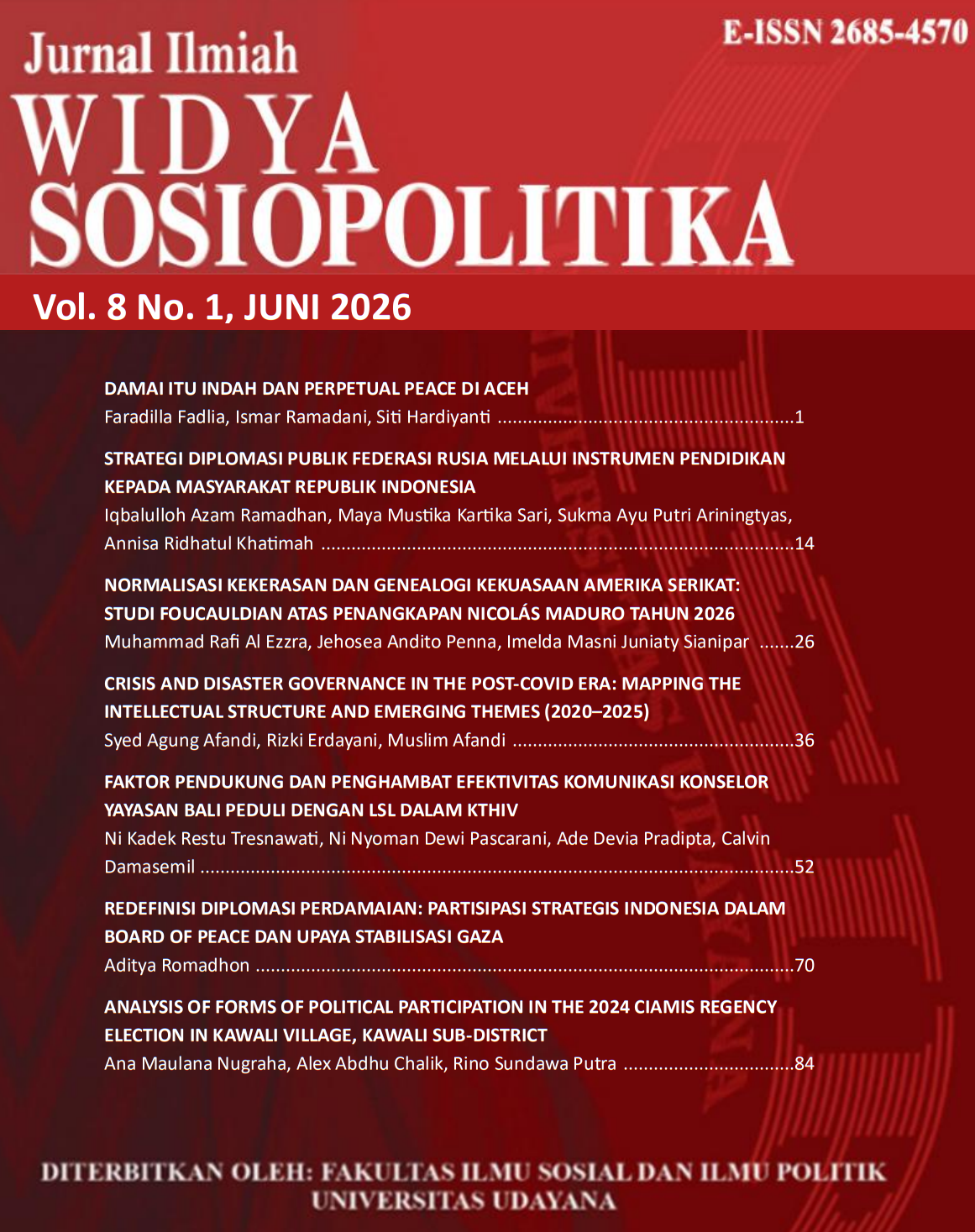
CRISIS AND DISASTER GOVERNANCE IN THE POST-COVID ERA: MAPPING THE INTELLECTUAL STRUCTURE AND EMERGING THEMES (2020–2025)
DOI:
https://doi.org/10.24843/JIWSP.2026.v08.i01.p04Keywords:
Bibliometric analysis, crisis governance, disaster governance, post-COVID eraAbstract
The COVID-19 pandemic has profoundly reshaped crisis and disaster governance, yet it remains unclear whether post-2020 scholarship reflects thematic expansion or paradigmatic restructuring within public administration. This study investigates the intellectual architecture of crisis governance research published between 2020 and 2025 through a bibliometric science-mapping approach. Drawing on Scopus and Web of Science data, the analysis integrates co-occurrence mapping, temporal overlay visualization, and density analysis to detect structural clustering, thematic intensification, and conceptual consolidation. The findings reveal strong interconnectivity across resilience governance, collaborative coordination, digital infrastructures, equity, and legitimacy, indicating epistemic consolidation rather than fragmentation. Resilience functions as the organizing logic of the field, while digital governance—particularly AI and data-driven tools—emerges as enabling architecture for adaptive coordination. Equity, trust, and communication operate as normative anchors linking institutional and technological domains. Rather than signaling theoretical rupture, the post-COVID period reflects paradigm layering and structural integration. The study advances public administration theory by demonstrating that crisis governance has shifted from an episodic management domain to a constitutive framework for governing under systemic uncertainty.
Downloads
Published
Issue
Section
License
Copyright (c) 2026 Syed Agung Afandi, Rizki Erdayani, Muslim Afandi (Author)

This work is licensed under a Creative Commons Attribution-NonCommercial-ShareAlike 4.0 International License.