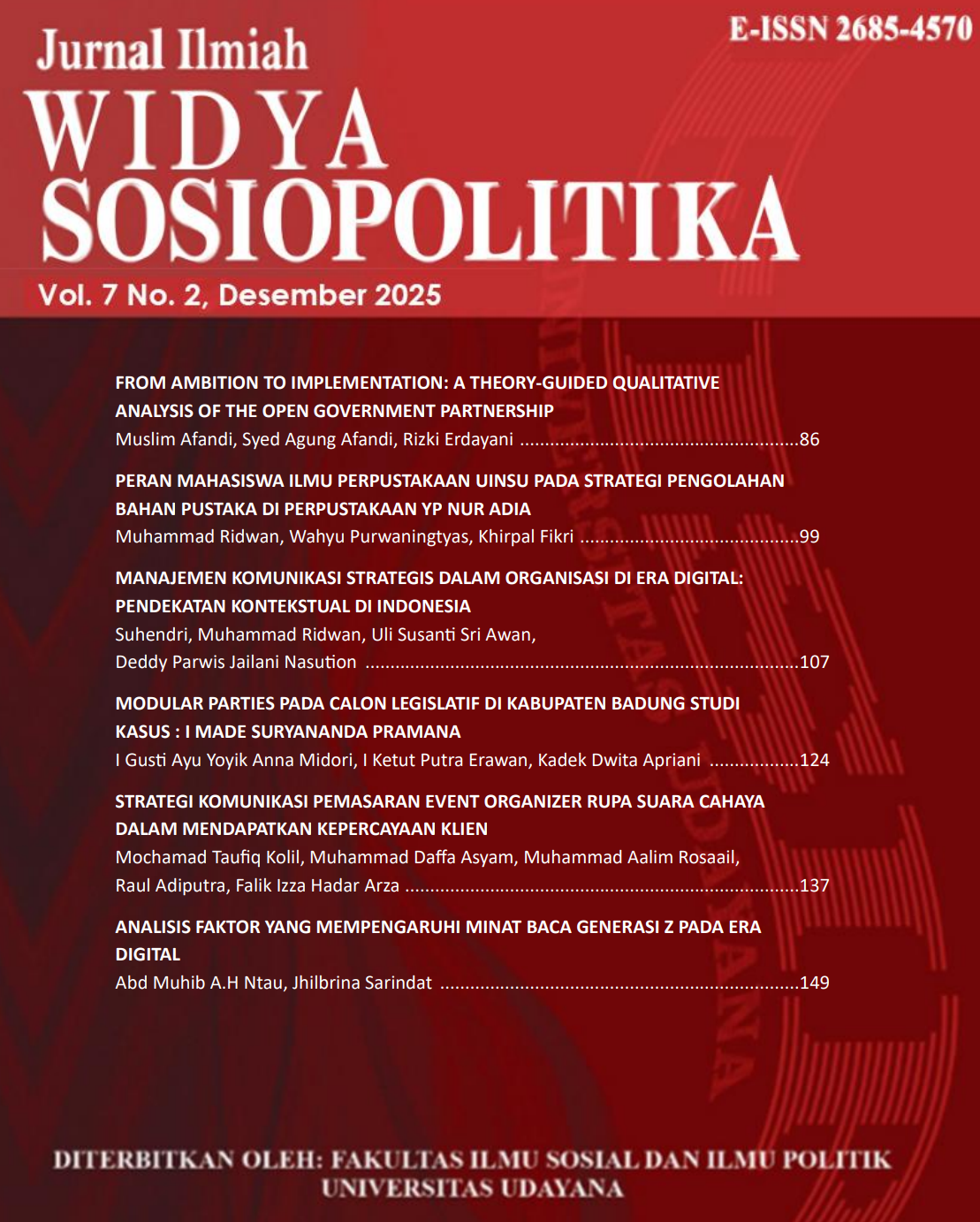
FROM AMBITION TO IMPLEMENTATION: A THEORY-GUIDED QUALITATIVE ANALYSIS OF THE OPEN GOVERNMENT PARTNERSHIP
DOI:
https://doi.org/10.24843/JIWSP.2025.v07.i02.p01Keywords:
Open government, Open Government Partnership, theory-guided qualitative analysisAbstract
This study examines the dynamics of the Open Government Partnership (OGP) as a global initiative aimed at promoting transparency, participation, and accountability in governance. Employing a qualitative-descriptive approach based on secondary data and guided by Theory Guided Qualitative Analysis (TGQA), the research integrates Independent Reporting Mechanism (IRM) reports, OGP Data Dashboard, and scholarly literature to identify patterns, trends, and variations in OGP implementation. Findings reveal that while OGP has expanded into a multi-level governance platform with 74 member countries and 152 local governments, regional disparities remain evident: Latin America stands out as a laboratory of participatory democracy, whereas Africa and Central Asia face structural and political constraints. Thematic analysis shows that classical issues such as fiscal transparency and public service delivery continue to dominate, yet the agenda has increasingly shifted toward justice, inclusion, climate governance, and lobbying regulation. However, IRM data highlight a persistent gap between ambition (44%), completion (60%), and transformative results (15%), underscoring the enduring implementation gap in governance reforms. These findings reinforce the view that OGP is not merely a technocratic platform but also a contested reform arena, where success largely depends on domestic political context, bureaucratic capacity, and civil society engagement.
Downloads
Published
Issue
Section
License
Copyright (c) 2025 Muslim Afandi, Syed Agung Afandi, Rizki Erdayani (Author)

This work is licensed under a Creative Commons Attribution 4.0 International License.