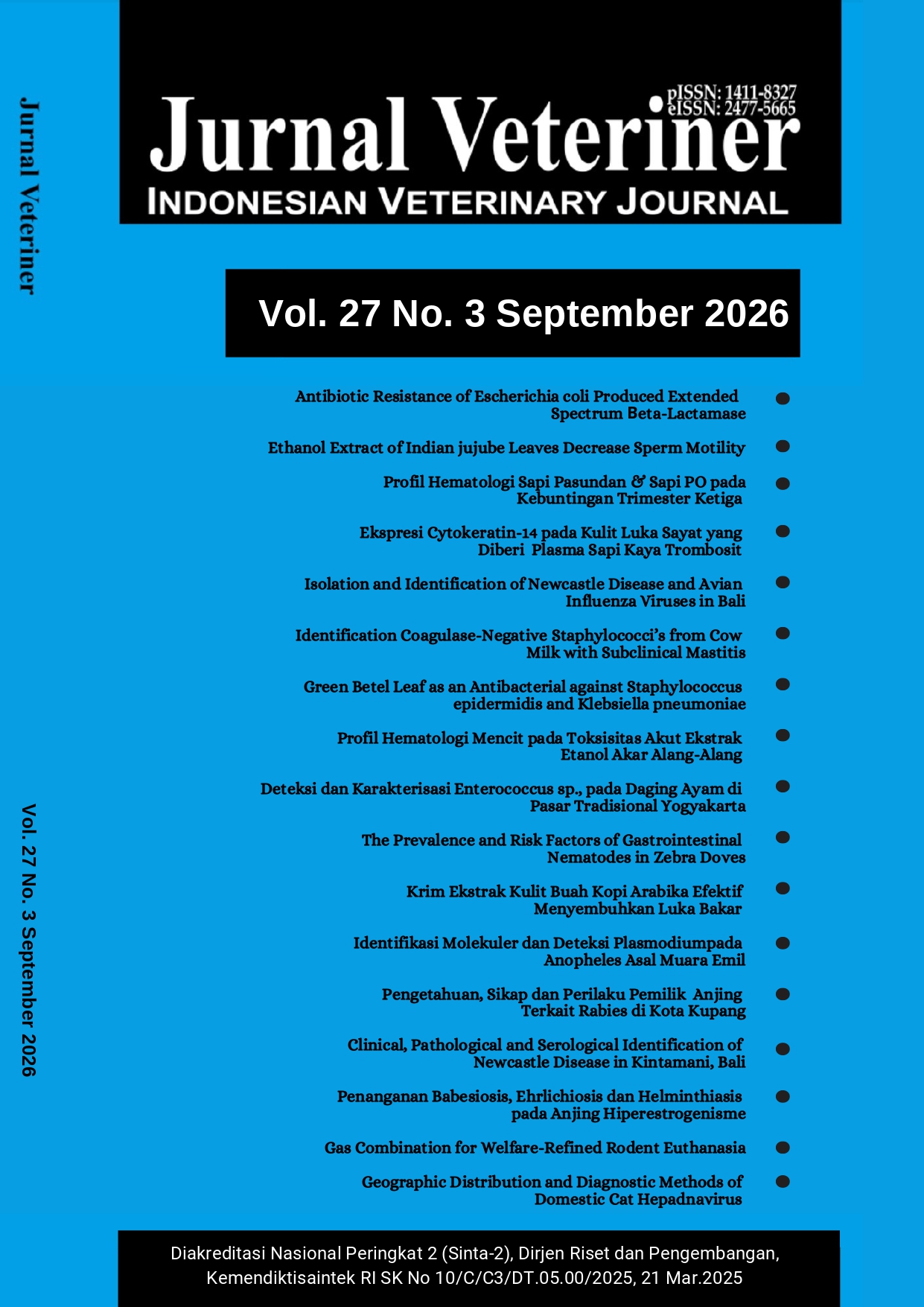
Clinical, Pathological and Serological Identification of Newcastle Disease in Chicken in Kintamani and Susut District of Bangli, Bali
Keywords:
avian virus, HA/HI test, Newcastle Disease, poultryAbstract
Newcastle Disease (ND), caused by Avian Paramyxovirus serotype 1 (APMV-1), remains endemic in Indonesia and continues to threaten poultry production due to its high transmissibility and economic impact. This study aimed to identify ND through an integrated clinical, pathological, and serological approach in commercial and indigenous chickens from Susut and Kintamani Districts, Bangli Regency, Bali. A total of 32 clinically suspected chickens (16 per district) were examined by necropsy, virus isolation in embryonated chicken eggs, and confirmation using hemagglutination (HA) and hemagglutination inhibition (HI) tests. Fifteen samples (46.88%) were confirmed ND-positive, comprising 7 (43.75%) from Susut and 8 (50%) from Kintamani. Digestive disorders were the predominant clinical sign (86.66%), and characteristic lesions were most consistently observed in the lungs (100%), intestines, and cecal tonsils (93.33%). Chickens from Kintamani had a 1.29-fold higher risk of ND infection compared to Susut (OR 1.29; 95% CI: 0.3–5.4). The study demonstrates active ND circulation in Bangli Regency and reveals variability in clinical expression potentially influenced by management systems and biosecurity practices. By integrating field-based clinical assessment with pathological and HA/HI confirmation, this research strengthens practical diagnostic reliability in resourcelimited settings and provides region-specific epidemiological evidence to support targeted vaccination strategies, enhanced biosecurity implementation, and sustainable poultry health management in endemic areas.
Downloads
Published
Issue
Section
License
Copyright (c) 2026 Inda Sabrina Latifah, Gusti Ayu Yuniati Kencana, Ida Bagus Kade Suardana, Tjokorda Sari Nindhia, Romy Muhammad Dary Mufa, I Made Kardena (Author)

This work is licensed under a Creative Commons Attribution 4.0 International License.
License Terms
This journal applies the terms of the Creative Commons Attribution 4.0 International License (CC BY 4.0).
Under this license, authors retain copyright and grant the journal the right of first publication. The published articles are freely available and can be:
-
Shared – copied and redistributed in any medium or format.
-
Adapted – remixed, transformed, and built upon for any purpose, even commercially.
Conditions:
-
Attribution – Appropriate credit must be given to the original author(s) and the source (the journal), a link to the license must be provided, and indication of any changes made must be included.
-
No additional restrictions – The licensor cannot apply legal terms or technological measures that legally restrict others from doing anything the license permits.
By submitting and publishing in this journal, authors agree to make their work available under the CC BY 4.0 License.
For more details, please visit: https://creativecommons.org/licenses/by/4.0/