
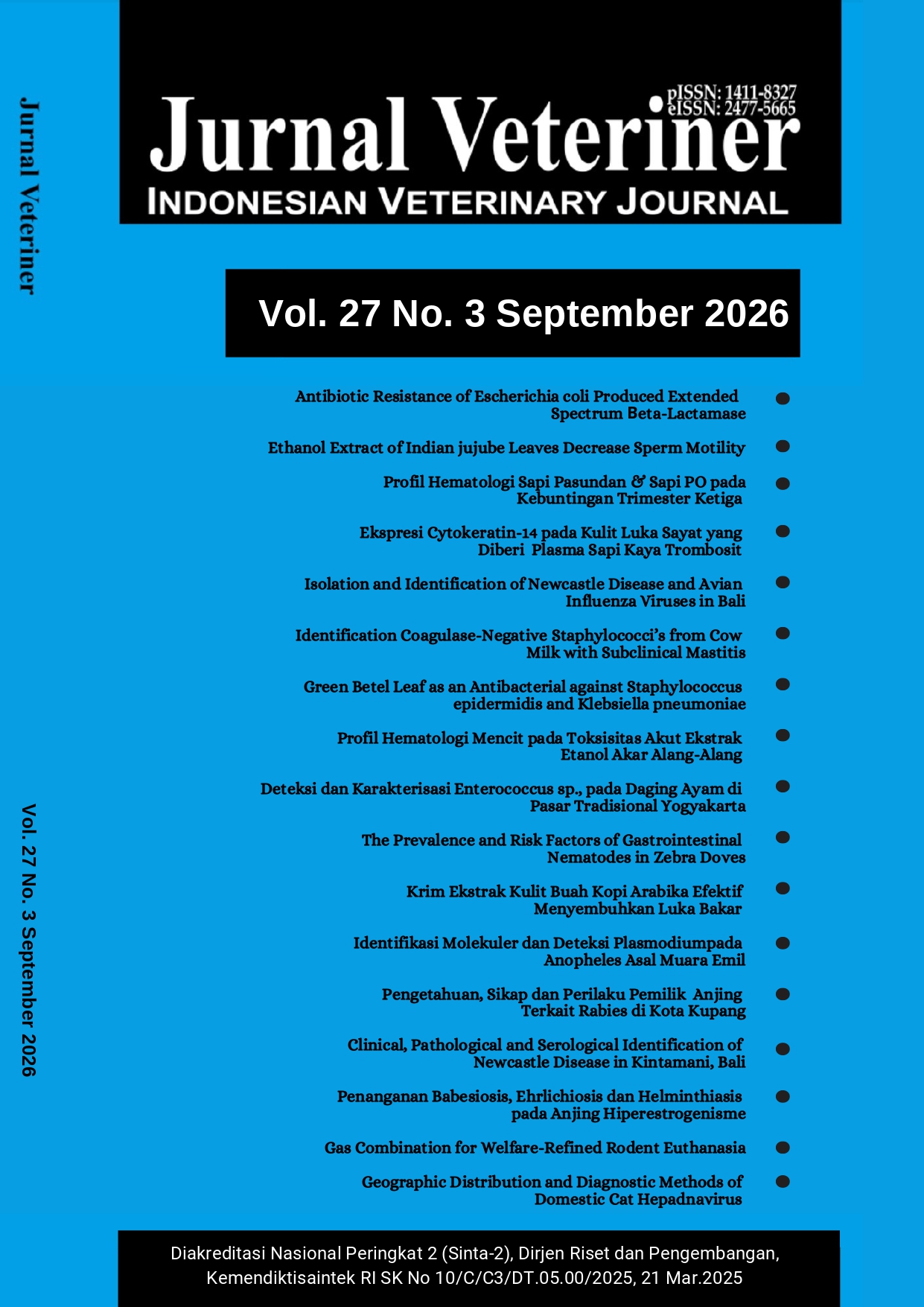
Antibiotic Resistance of Escherichia coli Produced Extended Spectrum Βeta-Lactamase In Broiler Chicken Meat of Banda Aceh City Markets
Keywords:
antibiotics, chicken meat, escherichia coli, ESBL, multidrug resistantAbstract
Broiler chicken meat is one of the animal proteins commonly consumed by the public due to its good nutritional content. Like other animal-based foods, broiler chicken meat is also highly perishable due to bacterial growth, including Escherichia coli. This bacterium has developed resistance to β-lactam antibiotics and other classes of antibiotics, leading to multidrug resistance. Extended spectrum β-lactamase (ESBL) is an enzyme capable of breaking down penicillin, first, second, and third generation cephalosporins, and monobactams. The main objective of this study was to determine the resistance of ESBL-producing E. coli in broiler chicken meat to several groups of antibiotics, namely ampicillin, kanamycin, cefotaxime, ceftazidime, and trimethoprim-sulfamethoxazole. This study used 47 samples of broiler chicken meat taken using random sampling. Broiler chicken meat samples were isolated to obtain ESBL-producing E. coli bacterial colonies. The detection of E. coli was performed using Eosin Methylene Blue Agar (EMBA) media mixed with cefotaxime antibiotic (2 µg/mL) and followed by testing the sensitivity to several antibiotics using the disc diffusion test. The results of the antibiotic testing were observed by measuring the diameter of the inhibition zone formed and interpreted with reference to the Clinical and Laboratory Standards Institute (CLSI) standards. Directly positive multidrug-resistant bacteria are defined as bacteria that are resistant to ≥3 types of antibiotics. The results showed that 10 samples (21.27%) were positive for E. coli bacteria with a resistance rate of 90% for cefotaxime, 80% for ceftazidime, 80% for ampicillin, 30% for kanamycin, and 80% for trimethoprim-sulfamethoxazole. Overall, ESBL-producing E. coli isolates from broiler chicken meat in Banda Aceh City Market showed resistance to more than three classes of antibiotics, thus categorized as multidrug resistance.
Downloads
Published
Issue
Section
License
Copyright (c) 2026 Rastina Rastina, Azhari, Ismail, Andi Novita, Teuku Reza Ferasyi, Denny Irmawati Hasan, Arlisa, Disnia Awliya Fithry, Pretty Reza Melenia (Author)

This work is licensed under a Creative Commons Attribution 4.0 International License.
License Terms
This journal applies the terms of the Creative Commons Attribution 4.0 International License (CC BY 4.0).
Under this license, authors retain copyright and grant the journal the right of first publication. The published articles are freely available and can be:
-
Shared – copied and redistributed in any medium or format.
-
Adapted – remixed, transformed, and built upon for any purpose, even commercially.
Conditions:
-
Attribution – Appropriate credit must be given to the original author(s) and the source (the journal), a link to the license must be provided, and indication of any changes made must be included.
-
No additional restrictions – The licensor cannot apply legal terms or technological measures that legally restrict others from doing anything the license permits.
By submitting and publishing in this journal, authors agree to make their work available under the CC BY 4.0 License.
For more details, please visit: https://creativecommons.org/licenses/by/4.0/