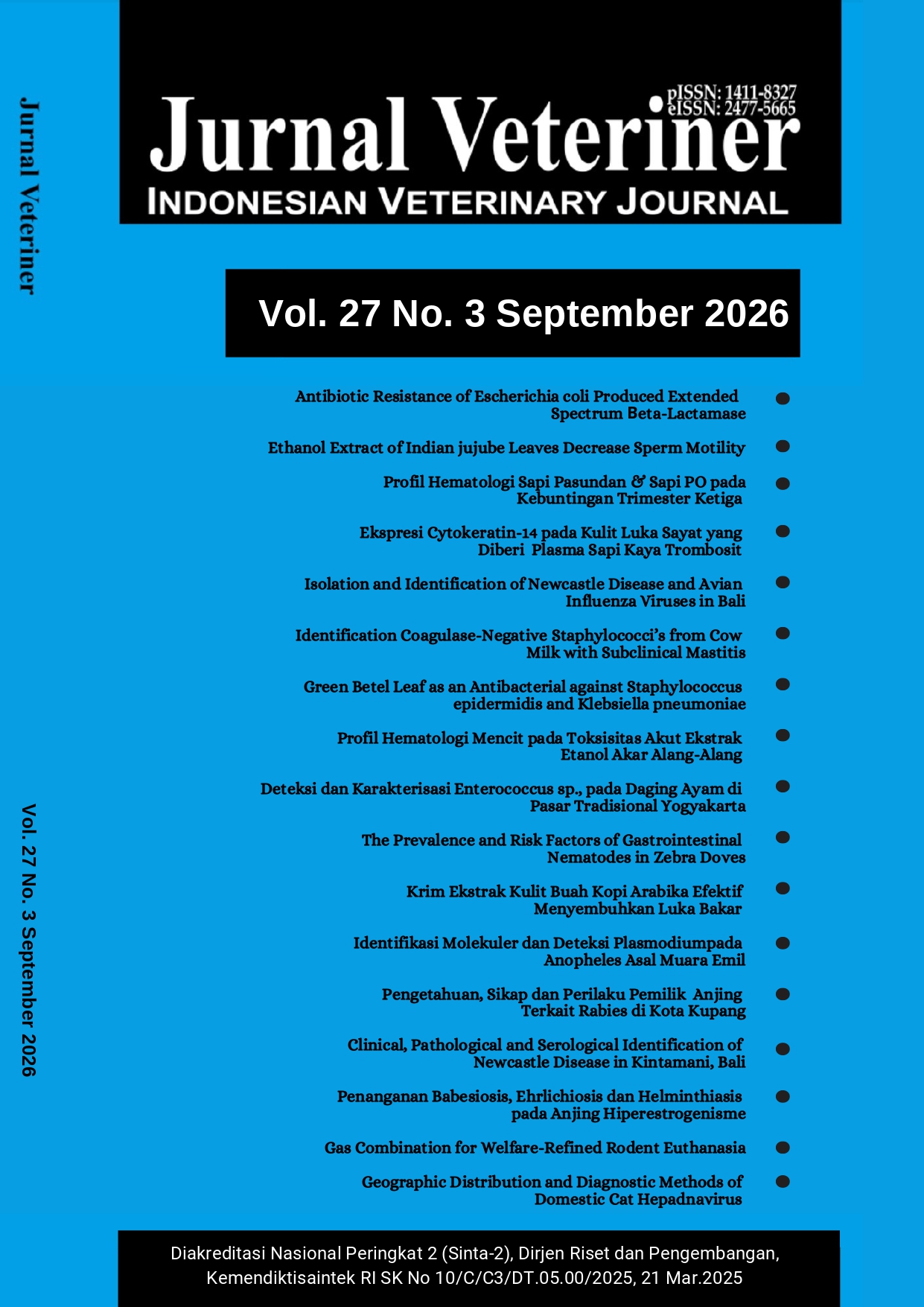
Beyond Single-Agent Euthanasia, Gas Combination for Welfare-Refined Rodent Euthanasia: A Narrative Review
Keywords:
animal welfare, carbon dioxide, gas-based euthanasia, nitrous oxide, rodent euthanasiaAbstract
Carbon dioxide (CO2) remains the most widely used euthanasia method for laboratory rodents because of its practicality and cost-effectiveness. Nevertheless, substantial evidence has raised welfare concerns related to hypercapnia-associated distress, nociceptor activation, and aversive behavioral responses prior to loss of consciousness. Inert gases such as nitrogen and argon have been proposed as alternatives, but their welfare implications remain variable and strongly dependent on delivery protocols. This narrative review synthesizes current evidence on gas-based euthanasia methods in laboratory rodents, with particular emphasis on emerging gas combination strategies, including carbon dioxide– nitrous oxide (CO2/N2O) mixtures. The review focuses on reported welfare-related outcomes, physiological mechanisms, and practical implementation considerations. A targeted and iterative literature search was conducted using PubMed/MEDLINE, Scopus, and Google Scholar to identify relevant studies published between 2000 and 2025. Experimental and comparative studies, reviews, and relevant regulatory guidelines involving mice and rats were included, and evidence was synthesized narratively due to substantial methodological heterogeneity. Across studies, single-agent gases exhibited distinct but not universally superior welfare profiles. Inert gases avoided hypercapnic acidosis but were associated with hypoxia-related behavioral responses under certain conditions. Selected CO2/N2O combinations were reported to achieve shorter induction times and fewer observable indicators of distress compared with CO2 alone, although findings were protocolspecific and based on limited evidence. Overall, gas combination approaches represent a context-dependent avenue for refinement rather than a universal replacement, underscoring the need for careful protocol selection and further research.
Downloads
Published
Issue
Section
License
Copyright (c) 2026 Nandira Rastya Febita, Puspa Kirani Putri Dwi Baskoro, Dyah Ayu Woro Setyaningrum, Arni Diana Fitri, Nany Hairunisa (Author)

This work is licensed under a Creative Commons Attribution 4.0 International License.
License Terms
This journal applies the terms of the Creative Commons Attribution 4.0 International License (CC BY 4.0).
Under this license, authors retain copyright and grant the journal the right of first publication. The published articles are freely available and can be:
-
Shared – copied and redistributed in any medium or format.
-
Adapted – remixed, transformed, and built upon for any purpose, even commercially.
Conditions:
-
Attribution – Appropriate credit must be given to the original author(s) and the source (the journal), a link to the license must be provided, and indication of any changes made must be included.
-
No additional restrictions – The licensor cannot apply legal terms or technological measures that legally restrict others from doing anything the license permits.
By submitting and publishing in this journal, authors agree to make their work available under the CC BY 4.0 License.
For more details, please visit: https://creativecommons.org/licenses/by/4.0/