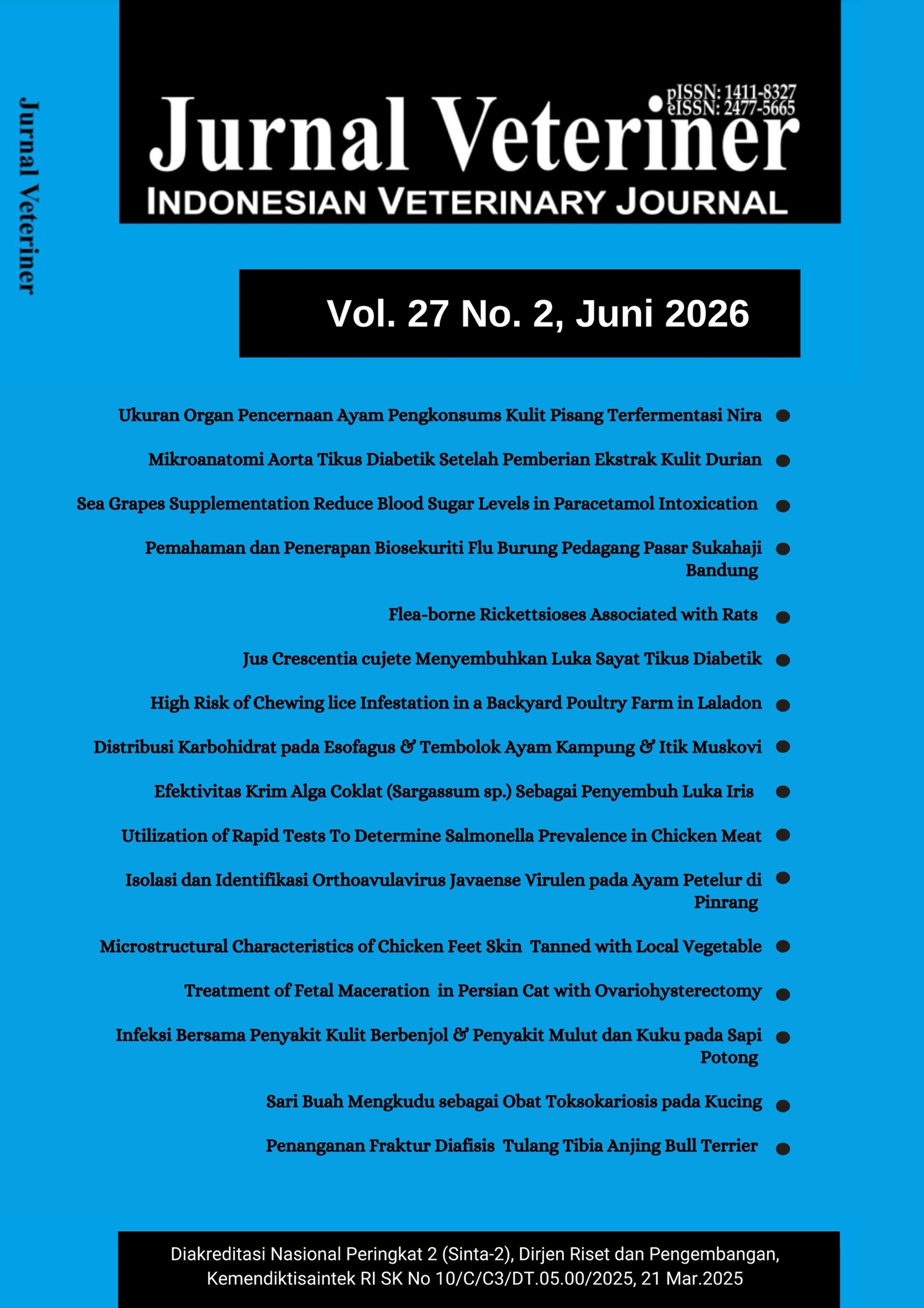
Physical and Microstructural Characteristics of Chicken Feet Skin Tanned with Local Vegetable Agents as Premium Leather Alternatives
DOI:
https://doi.org/10.19087/Keywords:
Chicken feet Skin, Local Tannins, Mechanical Properties of Leather, SEM Microstructure, Vegetable TanningAbstract
Abundant chicken feet skin waste remains underutilized despite its potential as high value exotic leather due to its unique natural scale patterns. This study was aimed to evaluates the utilization of broiler chicken feet skin through eco-friendly tanning by using local vegetable extracts: Sappan wood (Caesalpinia sappan), Acacia wood (Acacia sp.), and tea leaves (Camellia sinensis), with commercial textile dye as a control. A completely randomized design with four treatments and three replications (h=3) was employed. Raw material analysis revealed a proximate composition favorable for collagen-based tanning, dominated by a crude protein fraction of 25.67 ± 0.58. Results indicated that tanning agents significantly affected (p< 0.05) physical and mechanical properties. The highest thickness was observed in the Acacia treatment (0.54 ± 0.01 mm). While the control exhibited the highest tensile strength, Acacia yielded the highest strength among vegetable groups (1860.17 ± 10.00 N/cm²) but recorded the lowest elongation (19.68 ± 0.25%), indicating increased tissue stiffness. Tea leaf extracts produced the highest tear resistance among vegetable treatments (300.81 ± 0.20 N/cm). Scanning Electrone Microscope (SEM) confirmed consistent differences in porosity and micro cracking across treatments. These findings confirm that local vegetable tanning is a viable waste to resource strategy for producing sustainable, premium oriented alternative leather
Downloads
Published
Issue
Section
License
Copyright (c) 2026 Anas Qurniawan, Suci Ananda, Darmawan Risal (Author)

This work is licensed under a Creative Commons Attribution 4.0 International License.
License Terms
This journal applies the terms of the Creative Commons Attribution 4.0 International License (CC BY 4.0).
Under this license, authors retain copyright and grant the journal the right of first publication. The published articles are freely available and can be:
-
Shared – copied and redistributed in any medium or format.
-
Adapted – remixed, transformed, and built upon for any purpose, even commercially.
Conditions:
-
Attribution – Appropriate credit must be given to the original author(s) and the source (the journal), a link to the license must be provided, and indication of any changes made must be included.
-
No additional restrictions – The licensor cannot apply legal terms or technological measures that legally restrict others from doing anything the license permits.
By submitting and publishing in this journal, authors agree to make their work available under the CC BY 4.0 License.
For more details, please visit: https://creativecommons.org/licenses/by/4.0/