
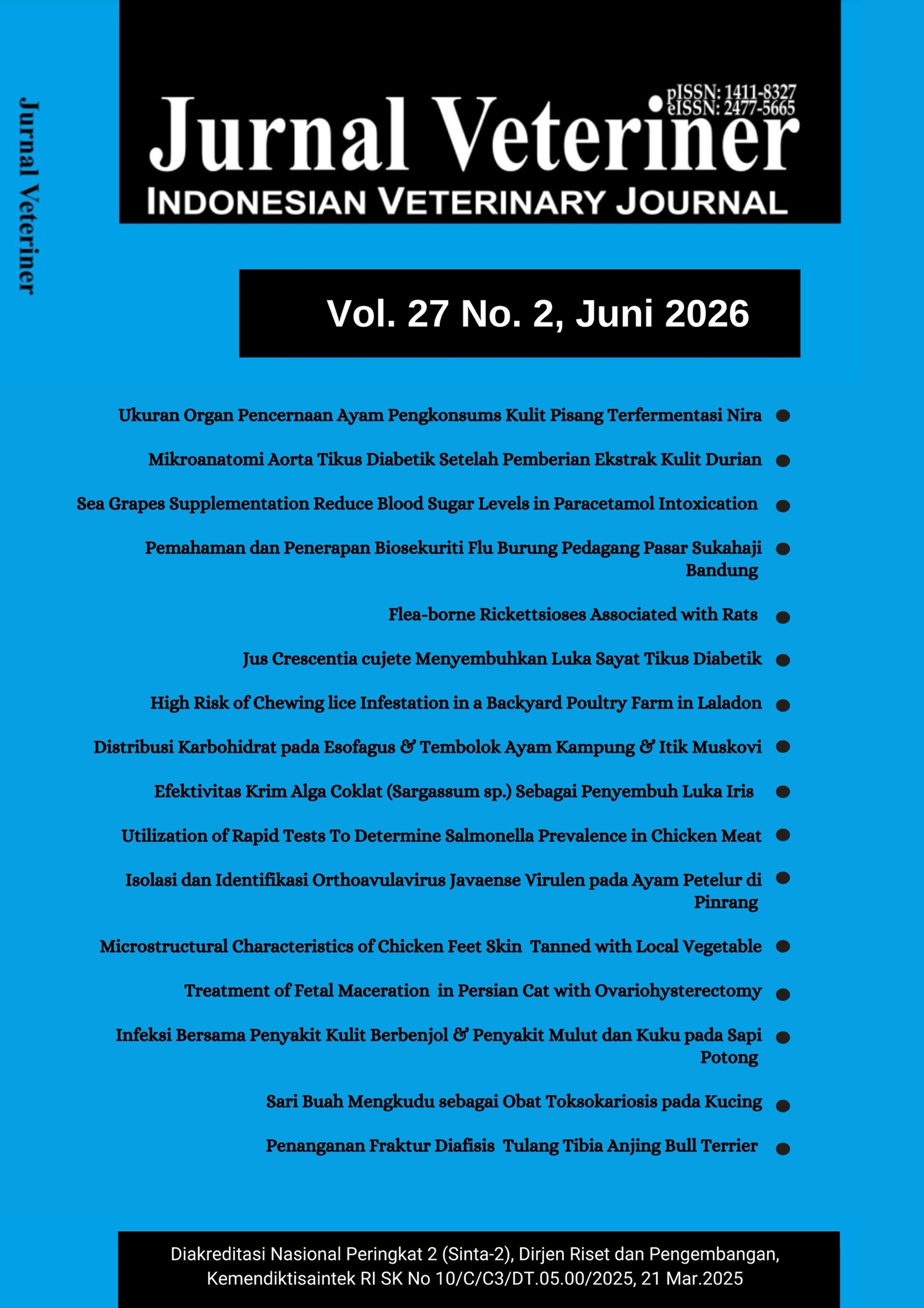
Utilization of Rapid Tests in Determining Salmonella Prevalence in Chicken Meat of Traditional Markets in West Sumatra, Indonesia
DOI:
https://doi.org/10.19087/Keywords:
Salmonella sp., Compact Dry SL, chicken meat, traditional markets, food safetyAbstract
Salmonella is a major foodborne pathogen responsible for numerous outbreaks of gastroenteritis worldwide and poultry products are recognized as one of its primary reservoirs. The risk of Salmonella contamination in chicken meat increases when hygienic practices during slaughtering, processing and marketing are inadequate, especially in traditional markets where temperature control and sanitation are often neglected. Rapid detection methods are crucial to identify contamination early and prevent potential outbreaks. This study was aimed to determine the occurrence of Salmonella sp. in chicken meat sold at traditional markets in West Sumatra, Indonesia, using the rapid test method. Sixty-five chicken meat samples were randomly collected from five traditional markets West Sumatera Province of Indonesia. Each sample was pre-enriched in Buffered Peptone Water and analyzed according to the manufacturer’s instructions. The presence of Salmonella colonies was confirmed by the appearance of blue-green colonies after 20-24 hours of incubation at 41°C. Results showed that 18 out of 65 samples (27,70%) were positive for Salmonella sp. indicating that contaminated chicken meat is still commonly found in traditional markets in West Sumatera. These findings highlight the need for improved hygiene management, proper meat handling and regular microbial surveillance in poultry retail environments. The Compact Dry SL method proved to be a simple, rapid and effective tool for routine screening of Salmonella contamination, suitable for use in local laboratories to support food safety control programs in developing regions.
Downloads
Published
Issue
Section
License
Copyright (c) 2026 Engki Zelpina, Prima Silvia Noor, Yurni Sari Amir, Suliha Suliha (Author)

This work is licensed under a Creative Commons Attribution 4.0 International License.
License Terms
This journal applies the terms of the Creative Commons Attribution 4.0 International License (CC BY 4.0).
Under this license, authors retain copyright and grant the journal the right of first publication. The published articles are freely available and can be:
-
Shared – copied and redistributed in any medium or format.
-
Adapted – remixed, transformed, and built upon for any purpose, even commercially.
Conditions:
-
Attribution – Appropriate credit must be given to the original author(s) and the source (the journal), a link to the license must be provided, and indication of any changes made must be included.
-
No additional restrictions – The licensor cannot apply legal terms or technological measures that legally restrict others from doing anything the license permits.
By submitting and publishing in this journal, authors agree to make their work available under the CC BY 4.0 License.
For more details, please visit: https://creativecommons.org/licenses/by/4.0/