AUTHOR GUIDELINES
These Author Guidelines are the latest revised guidelines and have been implemented since 2019 as part of efforts to improve the quality and update the publication standards of Acta Comitas. Publications issued in 2018 and earlier followed the writing guidelines applicable during those respective periods, also known as the Standard Operating Procedure (SOP).
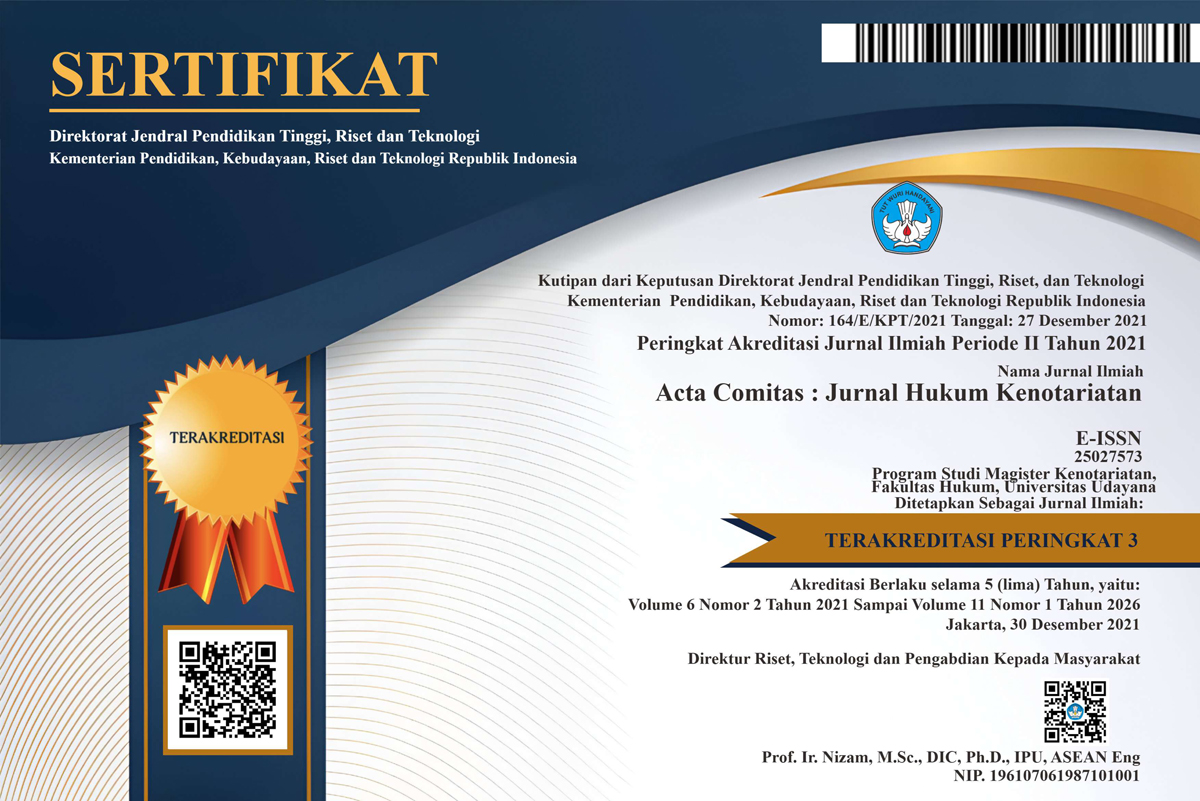
To improve services, publication quality, and support the journal’s re-accreditation, since 2025 Acta Comitas has adopted the Chicago Style citation format using the Mendeley reference management application. Volume 10, No. 2 (2025) was published in August 2025.
For ease of reference, the main requirements of the journal’s Author Guidelines are summarized in the following Writing Checklist:
|
Check List Author Guidelines: |
|
|||
|
No |
Author Guidelines |
|
|
|
|
|
|
|||
|
1. |
Articles must be prepared using the Journal Template available for download from the Acta Comitas website platform. |
|
|
|
|
2. |
The title must contain a maximum of 16 words, using Book Antiqua, 16 pt., centered. |
|
|
|
|
3. |
Abstract: must contain the objectives, methodology, and results/findings. Keywords: 3–5 words or phrases. Maximum 250 words, Book Antiqua, 10 pt., italic, single spacing.
|
|
|
|
|
4. |
Introduction: must contain the background, research problem, objectives, and state of the art as the basis for demonstrating the originality of the article. Use Book Antiqua, 11 pt., single spacing. Main headings must use numbering. Title Abstract 1. Introduction 2. Methods 3. Discussion 3.1…. 3.2…. 3.3…. 4. Conclusion 5. Acknoweledgement Reference |
|
|
|
|
5. |
Sources cited and the Reference List/Bibliography must be managed using Mendeley, with the citation style Chicago Manual of Style, 17th edition (full note, with Ibid)
|
|
|
|
|
6. |
The entire manuscript must use Book Antiqua, 11 pt., single spacing, except for the title (16 pt.) and the Abstract/Abstrak (10 pt.).
|
|
|
|
|
7. |
Authors are encouraged to maximize the use of primary sources, including journal articles, proceedings, theses, dissertations, legislation, international instruments, and court decisions, ideally comprising 80% of the references. The recommended ratio between books/literature and journal sources is approximately 20%:80%. |
|
|
|
|
8. |
|
|
|
|
|
9. |
Articles should contain approximately 3,500–10,000 words.
|
|
|
|
|
|
|
|
|
|
|
|
In order to improve services and publication quality and to support re-accreditation, Acta Comitas has adopted the Mendeley reference management application since 2025 for citations and bibliographies, using the Chicago Manual of Style, 17th edition (full note, with Ibid).
Examples of Citation Style
Journal Articles
I Gusti Ngurah Parikesit Widiatedja and I Gusti Ngurah Wairocana, “The Lack of the Environmental Concern in Indonesia’s Bilateral Investment Treaties,” Hasanuddin Law Review 3, no. 3 (2017): 231–245. DOI: 10.20956/halrev.v3i3.1202.
Damiano De Felice, “Business and Human Rights Indicators to Measure the Corporate Responsibility to Respect: Challenges and Opportunities,” Human Rights Quarterly 37, no. 2 (2015): 511–555. DOI: 10.1353/hrq.2015.0031.
I Made Arya Utama and I Nengah Suharta, “The Challenges of Water Pollution: Enforcement of Water Pollution Control,” Hasanuddin Law Review 4, no. 1 (2018): 81–87. DOI: 10.20956/halrev.v4i1.1414.
Made Jayantara, “Instrumen Rekomendasi DPRD Dalam Penyelenggaraan Kewenangan Perijinan Oleh Pemerintah Daerah,” Jurnal Magister Hukum Udayana 4, no. 3 (2015): 144–166. DOI: 10.24843/jmhu.2015.v04.i03.p07.
Books
Azheri, Busyra. Corporate Social Responsibility: Dari Voluntary Menjadi Mandatory. Jakarta: Raja Grafindo Persada, 2011.
Ni Ketut Supasti Dharmawan. Hak Kekayaan Intelektual dan Harmonisasi Hukum Global (Rekonstruksi Pemikiran Terhadap Perlindungan Program Komputer). Semarang: Badan Penerbit Universitas Diponegoro, 2011.
Journal Policy
Acta Comitas is a scholarly legal journal published by the Faculty of Law, Universitas Udayana, Bali. Only legal articles that comply with the journal’s Author Guidelines are eligible for publication. All manuscripts submitted to and published in the journal undergo a peer-review process.
Review Policy
All manuscripts submitted to Acta Comitas undergo a review process conducted by the Editorial Board and a team of reviewers or validators with relevant expertise and competence in the subject matter of the submitted article. Upon completion of the review process, the Editorial Board conducts the final stages of the article publication process.
Open Access Policy
Acta Comitas adopts an Open Access Journal policy intended to facilitate the broad dissemination of research findings to the general public and to contribute to the development and exchange of scholarly knowledge, particularly in the field of law, on a global scale.
Article Format
Articles submitted for publication must contain at least 3,500 words, including footnotes, abstract, and references. The font used throughout the manuscript is Book Antiqua, 11 pt., single spacing.
The required structure of an article is:
Title, Abstract (in English and Indonesian), Keywords, Introduction, Research Method, Results and Discussion, Conclusion, and References.
Title
- The title must be relevant to the substance of the article, informative and engaging, and contain a maximum of 16 words.
- The title must be written in Book Antiqua, 16 pt.
Examples:
- The Authority of Notaries in the Preparation of Authentic Deeds
- Electronic-Based Management of Notarial Protocols: A Cyber Notary Study
For authors whose names consist of only one word, the online version (HTML) should display the name twice for metadata indexing purposes.
Example:
- Author's name: Marwanto
- Online display name: Marwanto Marwanto
Abstract
The abstract must be written in two languages: English and Indonesian. The abstract heading must be in bold, while the body of the abstract must use Book Antiqua, 10 pt., italic, single spacing.
The abstract must consist of one paragraph and contain a maximum of 250 words, covering:
- Purpose of the study;
- Research methodology; and
- Research results/findings or conclusions.
Keywords may consist of individual words or phrases and must contain 3–5 words or phrases.
Examples of keyword phrases:
Law Enforcement;
Cyber Notary;
Authentic Deed.
Article Section Headings
Each main heading and sub-heading in the journal must use a numbering format:
- Main Heading
- Main Heading
2.1. Sub-heading
2.1.1. Sub-sub-heading
Example:
1. Introduction
Introduction
The Introduction must provide an adequate background to the issue, identify the research problem, state the objective of the article, and present the state of the art of previous research and publications. This should demonstrate the originality of the submitted article and its contribution to the development of legal scholarship.
The Introduction should also explain the research gap and/or the urgency of the study. Accordingly, the article should clearly state the novelty of the research, supported by a review of previous studies. The state of the art should preferably be supported by primary sources, particularly relevant and recent journal publications, both international and national, as well as theses and dissertations.
Research Method
For articles based on research, the research method must be presented as a separate section following the Introduction. The Research Method should explain the type of research, research approach, sources of legal materials and/or data, techniques for collecting legal materials and data, and methods of analyzing legal materials and/or data.
For conceptual articles, it is sufficient to explain the research approach or analytical approach, which should be presented at the end of the Introduction.
Example:
2. Research Method
Results and Discussion
The Results and Discussion section must present the research results or scientific findings, followed by a scholarly discussion and analysis. The discussion should be descriptive, analytical, and critical.
The discussion must follow the sequence of the legal issues that constitute the main focus of the study. The analysis may be supported by tables presented horizontally. Each table must include a “Table Title” and “Source.” Every table must be followed by the author's analysis and commentary as part of the discussion.
In addition to tables, statutory provisions and other regulations included in the article must be accompanied by an analysis and the author's views in order to strengthen and sharpen the arguments presented.
Example:
3. Results and Discussion
- Regulation of Notarial Authority in the Preparation of Authentic Deeds
- …………
- …………
- Electronic-Based Management of Notarial Protocols: A Cyber Notary Study
- …………
- …………
Conclusion
The Conclusion section should summarize the main findings of the study and provide direct answers to the research problems addressed in the article. The conclusion must follow the sequence of the research problems and remain consistent with the research objectives.
No new discussion or additional commentary should be introduced in the Conclusion. The Conclusion must be written in one paragraph.
Example:
4. Conclusion
Declaration
Statement on the Use of Artificial Intelligence (AI)
Authors are required to transparently declare whether Artificial Intelligence (AI) was used in the preparation of the article. If AI was used, authors must state the name of the tool used and explain the purpose and manner of its use. For example:
“This research did not use Artificial Intelligence (AI) assistance,” or;
“This research utilized Artificial Intelligence (AI), specifically ……………., to …………………… The authors declare that the use of AI was conducted responsibly and transparently and did not replace the authors’ intellectual contributions, scientific judgment, or responsibility. The authors remain fully responsible for the accuracy, originality, validity, integrity, references, and compliance with ethical principles of all content of the article, including any sections drafted or revised with AI assistance. The authors further guarantee that AI was not used to create, fabricate, falsify, or manipulate data, research/activity results, documentation, information, or references.”
Funding Statement
Authors are required to declare whether the research received funding. If the research received external funding from any institution or party, the authors must disclose such funding transparently. For example:
“This research was independently funded by all authors,” or
“This research was funded by the Directorate General of Higher Education, Research, and Technology under the Basic Research Scheme in 2025.”
Conflict of Interest
To maintain the accuracy, credibility, objectivity, and trustworthiness of the authors’ work, authors must declare whether any conflict of interest exists in relation to the research article. For example:
“The authors declare that there is no conflict of interest in this article.”
Footnotes
Acta Comitas uses footnotes for cited sources. Footnotes must be prepared using Mendeley, with the citation style Chicago Manual of Style, 17th edition (full note, with Ibid).
Examples of Footnotes from Books/Literature
Peter Van den Bossche, The Law and Policy of the World Trade Organization: Text, Cases and Materials, Cambridge University Press, 2008, pp. 332–335.
Jan Hendrik Peters, Tri Hita Karana the Spirit of Bali. Jakarta: Kepustakaan Populer Gramedia, 2013, p. 75.
Examples of Footnotes from Journal Articles
I Gusti Ngurah Parikesit Widiatedja and I Gusti Ngurah Wairocana, “The Lack of the Environmental Concern in Indonesia’s Bilateral Investment Treaties,” Hasanuddin Law Review 3, no. 3 (2017): 231–245. DOI: 10.20956/halrev.v3i3.1202.
Damiano De Felice, “Business and Human Rights Indicators to Measure the Corporate Responsibility to Respect: Challenges and Opportunities,” Human Rights Quarterly 37, no. 2 (2015): 511–555. DOI: 10.1353/hrq.2015.0031.
Ni Ketut Supasti Dharmawan, Made Sarjana, and Putu Aras Samshitawrati, “Perusahaan Dan Konservasi Keanekaragaman Hayati Laut: The Right to Tourism vs Sustainable Tourism,” Masalah-Masalah Hukum 46, no. 2 (2018): 125–135. DOI: 10.14710/mmh.46.2.2017.125-135.
Made Jayantara, “Instrumen Rekomendasi DPRD Dalam Penyelenggaraan Kewenangan Perijinan Oleh Pemerintah Daerah,” Jurnal Magister Hukum Udayana 4, no. 3 (2015): 144–166. DOI: 10.24843/jmhu.2015.v04.i03.p07.
Example of a Footnote from an Official Website
World Trade Organization, Understanding the WTO Agreement Intellectual Property and Enforcement. Available from https://www.wto.org/english/thewto_e/whatis_e/tif_e/agrm7_e.htm (accessed May 5, 2018).
References
The Reference List must contain all sources cited in the article. References should preferably be drawn from publications issued within the last 10 years. The composition of the reference list should maximize the use of journal articles and other primary sources, with such sources preferably accounting for up to 80% of the total references.
Only sources cited in the manuscript should be included in the Reference List. The Reference List must be prepared using Mendeley with the Chicago Manual of Style, 17th edition (full note, with Ibid) citation style.
References from Books/Literature
One-author book
Format:
Author's Name. Book Title. Place of Publication: Publisher, Year.
Example:
Azheri, Busyra. Corporate Social Responsibility: Dari Voluntary Menjadi Mandatory. Jakarta: Raja Grafindo Persada, 2011.
Ni Ketut Supasti Dharmawan. Hak Kekayaan Intelektual dan Harmonisasi Hukum Global (Rekonstruksi Pemikiran Terhadap Perlindungan Program Komputer). Semarang: Badan Penerbit Universitas Diponegoro, 2011.
Two-author book
Format:
First Author's Name, Second Author's Name. Book Title. Place of Publication: Publisher, Year.
Example:
Ida Bagus Wyasa Putra and Ni Ketut Supasti Dharmawan, Hukum Perdagangan Internasional. Bandung: PT Refika Aditama, 2017.
Jan Hendrik Peters and Wisnu Wardana, Tri Hita Karana the Spirit of Bali. Jakarta: Kepustakaan Populer Gramedia, 2013.
Journal Article References
I Gusti Ngurah Parikesit Widiatedja and I Gusti Ngurah Wairocana, “The Lack of the Environmental Concern in Indonesia’s Bilateral Investment Treaties,” Hasanuddin Law Review 3, no. 3 (2017): 231–245. DOI: 10.20956/halrev.v3i3.1202.
Damiano De Felice, “Business and Human Rights Indicators to Measure the Corporate Responsibility to Respect: Challenges and Opportunities,” Human Rights Quarterly 37, no. 2 (2015): 511–555. DOI: 10.1353/hrq.2015.0031.
I Made Arya Utama and I Nengah Suharta, “The Challenges of Water Pollution: Enforcement of Water Pollution Control,” Hasanuddin Law Review 4, no. 1 (2018): 81–87. DOI: 10.20956/halrev.v4i1.1414.
Thesis or Dissertation References
The format is: author's name, year in parentheses, title of thesis/dissertation in italics, and name of university.
Example:
Dewa Gede Rudy. Pengaturan Hak Usaha Mikro Kecil dan Menengah (UMKM) Atas Akses Modal di Bidang Usaha Pariwisata. Universitas Udayana, 2015.
Online Sources / World Wide Web
The format for online sources is:
Author's last name, initials. (Year). Title of Article. Retrieved from Website Name.
Example:
United Nations and the Rule of Law. (2015). Environmental Law. Retrieved from https://www.un.org/ruleoflaw/thematic-areas/land-property-environment/environmental-law/, accessed May 6, 2018.
Tables and Figures
Authors may include tables and figures where necessary to strengthen the analysis presented in the article. Tables and figures included in the manuscript must be numbered and provided with titles.
The title of a table must be placed above the table, while the title of a figure must be placed below the figure. Tables should use horizontal lines rather than vertical lines.
Journal Copyright Statement
The journal allows authors to retain copyright without restriction and permits authors to retain unrestricted publishing rights.