PUBLICATION ETHICS
The management of Acta Comitas: Jurnal Hukum Kenotariatan is conducted in accordance with established publication ethics, covering the overall ethical standards of journal management, including the Open Access Policy, Publication Frequency, Editorial Board Ethics Policy, Reviewer Ethics Policy, and Authors Ethics Policy. In accordance with these publication ethics, the journal is published through an Open Journal System (OJS). The journal is published regularly three times a year, in April, August, and December. All published articles undergo a review process by the Board of Editors as well as a review process conducted by the reviewer team. Articles are published in accordance with the journal's Focus and Scope, Author Guidelines, and Journal Template.
Open Access Policy Ethics
This journal is an electronic Open Access Journal. In accordance with its ethical principles, all articles published in the journal are openly accessible to readers, with the aim of supporting the global dissemination and advancement of knowledge, particularly research and scholarly studies in the field of Notarial Law, encompassing local, national, and international legal contexts.
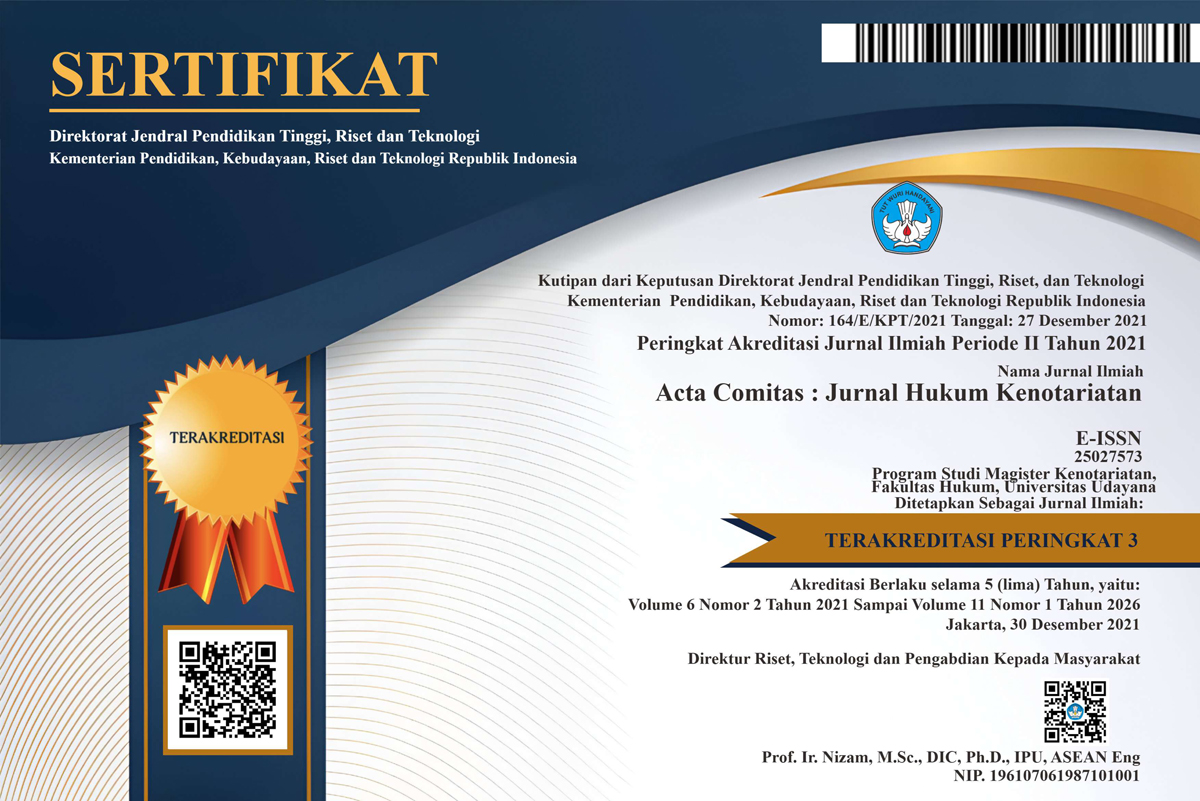
As part of efforts to improve quality in accordance with national journal accreditation standards, the management of Acta Comitas is continuously enhanced in terms of both technical management and academic substance. These improvements include strengthening the quantity and quality of human resources within the Editorial Board and reviewer team, both internally and externally, as well as improving the quality of published articles through similarity checking using Turnitin.
The publication of articles in this journal follows a Peer-Review Process, beginning with an initial assessment and review of the Journal Template by the Board of Editors or Editorial Board. The editors have relevant experience in journal management and are responsible for carefully examining and ensuring that submitted articles comply with the Author Guidelines and Journal Template.
As part of the review conducted by the Editorial Team, submitted manuscripts are also subject to a similarity check using Turnitin. This process is intended to uphold the integrity, academic responsibility, honesty, and ethical standards of authors and to ensure that submitted scholarly works do not contain indications of plagiarism. The maximum acceptable similarity threshold is 20%.
Authors submitting articles to Acta Comitas are required to comply with the Author Guidelines, prepare their manuscripts in accordance with the Journal Template, and adhere to the journal's Publication Ethics.
Acta Comitas: Jurnal Hukum Kenotariatan is committed to maintaining integrity, transparency, objectivity, accountability, confidentiality, and compliance with ethical principles throughout every stage of the scholarly publication process. These provisions apply to all parties involved in the management and publication of the journal, including the Editorial Team, Peer Reviewers, and Authors.
The publication ethics of Acta Comitas: Jurnal Hukum Kenotariatan are guided by established principles and best practices for ethical scholarly publishing, as developed by COPE Principles of Transparency and Best Practice in Scholarly Publishing
Publication Ethics For Authors
Authors who wish to publish their articles in this journal are required to comply with the requirements set forth in the Author Guidelines and Journal Template. Authors must present their research methods clearly and accurately, in accordance with accepted research methodologies in the field of legal scholarship. All data presented, including data in tables, must clearly indicate their sources. Dishonesty in the presentation of data or references constitutes unethical conduct and will not be tolerated by this journal. Authors are required to comply with the following provisions:
- Originality and Plagiarism: Authors must ensure that submitted manuscripts are their own original work and are free from any form of plagiarism, fabrication, or falsification of data. Originality is assessed through a Turnitin similarity check. Where authors use findings or works from previous studies to support their articles, they must ensure that such sources are properly and ethically acknowledged through appropriate footnotes.
- Duplicate Publication: Authors must not submit the same article to multiple journals simultaneously. Articles that have already been published elsewhere may not be submitted to this journal, as such conduct constitutes unethical publishing practice.
- Authorship: The names listed as authors must correspond to all individuals who have made substantive and meaningful contributions to the research and preparation of the manuscript.
- Conflict of Interest: Authors must transparently disclose any relevant financial or personal conflicts of interest that may influence the results or interpretation of the research.
- Correction of Errors: Authors must promptly notify the Editor if they discover any significant errors or inaccuracies in their manuscript, either before or after publication, so that appropriate corrections or errata can be made.
Publication Ethic for Reviewers
All articles published in this journal undergo a peer-review process conducted by reviewers. Reviewers are responsible for evaluating the substance of submitted articles and assisting authors through constructive comments and recommendations concerning the state of the art and other relevant substantive components. Reviewers must provide clear assessments, views, and recommendations supported by sound reasoning and arguments.
Reviewers are also responsible for carefully assessing and identifying the relevance of legal documents, concepts, theories, and relevant previous studies used by authors in their analysis. Personal criticism of authors is considered unethical and inappropriate during the review process. In reviewing manuscripts, reviewers must comply with the following provisions:
- Confidentiality: Reviewers must maintain the confidentiality of manuscripts and all information contained therein throughout the review process. Manuscripts must not be discussed with or shown to any other party without written permission from the Editor.
- Objectivity: Reviewers must conduct the review ethically and objectively, focusing their comments and recommendations on the substantive quality of the article.
- Conflict of Interest: Reviewers must promptly disclose any potential conflict of interest to the Editor and decline the review assignment if they have any competitive, collaborative, or other relationship with the author(s) or affiliated institution(s) that could compromise their objectivity.
- Integrity of Information: Reviewers must not use unpublished information, data, or ideas contained in submitted manuscripts for personal purposes or commercial benefit.
Publications Ethics for The Editorial Team
In managing the journal and carrying out editorial responsibilities, the Editorial Team must adhere to the following principles:
- Independent Decision-Making: The Editorial Board must make editorial decisions regarding acceptance or rejection independently, fairly, and objectively, based on the scholarly quality of the manuscript, without discrimination based on the author's race, gender, religion, ethnicity, nationality, or political philosophy.
- Confidentiality: The Editorial Board must strictly maintain the confidentiality of reviewer identities in accordance with the Blind Peer Review policy implemented by the journal.
- Handling of Misconduct: The Editorial Board is responsible for addressing allegations of publication ethics violations in a transparent, systematic, and accountable manner, in accordance with the COPE guidelines and procedures.
- Corrections and Retractions: The Editorial Board is prepared to publish corrections, clarifications, or issue retractions when authentic evidence of significant errors or ethical violations is identified after publication.
Further Information
Further guidance and comprehensive information regarding international standards for publication ethics are available through the official website of the Committee on Publication Ethics (COPE) COPE Guidance.