Editorial Process
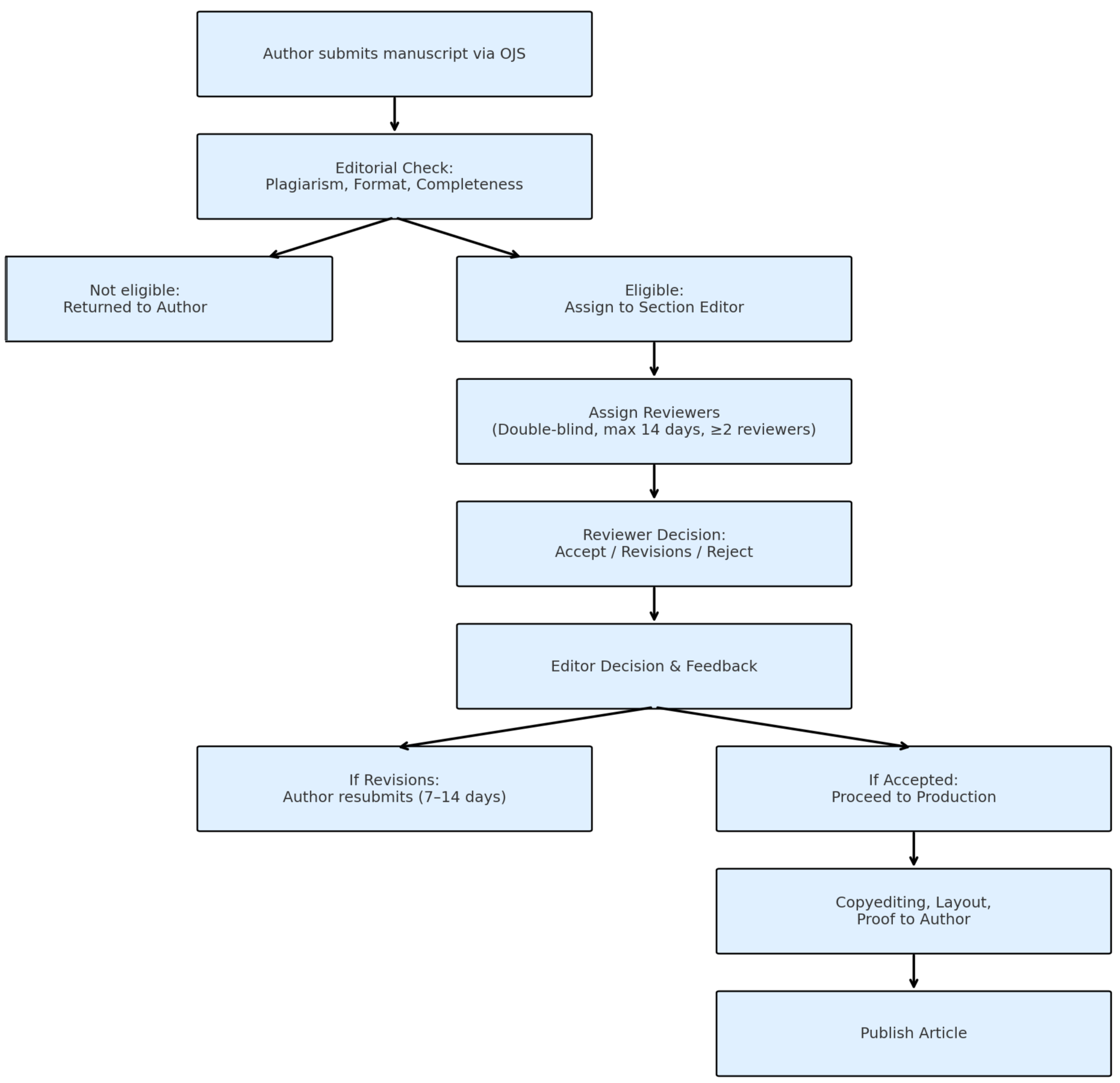
Jurnal Anestesi dan Terapi Intensif (JATI) follows a rigorous editorial and peer review process to ensure the integrity, quality, and relevance of all published content. The process is managed entirely through the Open Journal Systems (OJS) 3.4 platform.
1. Submission Stage
Authors must submit manuscripts exclusively via the OJS 3.4 online submission system. At this stage, authors are required to:
-
Complete all metadata fields (title, abstract, keywords, author affiliations, corresponding author details).
-
Upload the main manuscript file, tables, figures, and supplementary materials.
-
Provide supporting documents, including ethical approval letters (if applicable), conflict of interest statements, funding disclosures, and cover letters.
Submissions that do not meet these requirements may be returned to authors before processing.
2. Initial Editorial Screening
Upon submission, the Editor-in-Chief or designated Editorial Manager conducts an initial evaluation to verify:
-
Plagiarism check (using Turnitin or equivalent software; manuscripts with >20% similarity may be returned or rejected).
-
Compliance with the journal’s scope, author guidelines, and formatting requirements.
-
Completeness of supporting documents, including ethics approvals and declarations.
Manuscripts failing to meet minimum standards are returned to authors for correction or may be declined at this stage.
3. Assignment to Section Editor
Manuscripts passing the initial screening are assigned by the Editor-in-Chief to a Section Editor, who oversees the peer review process.
4. Peer Review Process
-
JATI implements a double-blind peer review policy, ensuring that both authors and reviewers remain anonymous.
-
Each manuscript is evaluated by at least two independent reviewers with expertise relevant to the subject matter.
-
Reviewers are expected to submit their assessments, structured review forms, and annotated files within 14 days.
-
Possible review recommendations include: Accept Submission, Minor Revisions, Major Revisions, or Reject Submission.
5. Editorial Decision
The Section Editor consolidates reviewer reports and submits a recommendation to the Editor-in-Chief. Based on the reviewers’ feedback and editorial judgment, the Editor-in-Chief issues one of the following decisions: Accept, Minor Revisions, Major Revisions, or Reject. Decisions are communicated to the authors through OJS, accompanied by detailed reviewer comments and instructions for revision where applicable.
6. Author Revision
If revisions are required:
-
Authors are expected to resubmit a revised manuscript along with a point-by-point response to reviewers within 7 days (minor revisions) or 14–21 days (major revisions).
-
Revised manuscripts may be re-evaluated by the original reviewers (in the case of major revisions) or by the editor (for minor revisions).
-
Failure to resubmit within the specified timeframe may result in the withdrawal of the manuscript.
7. Acceptance and Production
Following final acceptance, manuscripts proceed to the production stage:
-
Copyediting: Manuscripts are reviewed for grammar, clarity, style, referencing, and adherence to journal standards.
-
Layout Editing: The article is formatted into the journal’s official style for online publication.
-
Proofreading: Authors receive page proofs via OJS for final approval. Authors are responsible for carefully reviewing and approving the proofs before publication.
8. Publication
-
Final articles are assigned a Digital Object Identifier (DOI).
-
Articles are published online in the assigned issue (February, June, October).
-
Metadata is deposited for indexing and archiving (e.g. DOAJ, Google Scholar, Garuda, and other services as applicable).
-
All articles are published Open Access under the Creative Commons Attribution (CC BY 4.0) license.
9. Post-Publication
-
Authors and readers may report errors or ethical concerns post-publication. If necessary, the journal will issue corrections, expressions of concern, or retractions in line with COPE guidelines.
-
Authors may appeal editorial decisions by submitting a reasoned request to the Editor-in-Chief. Appeals will be considered carefully and may involve re-review.