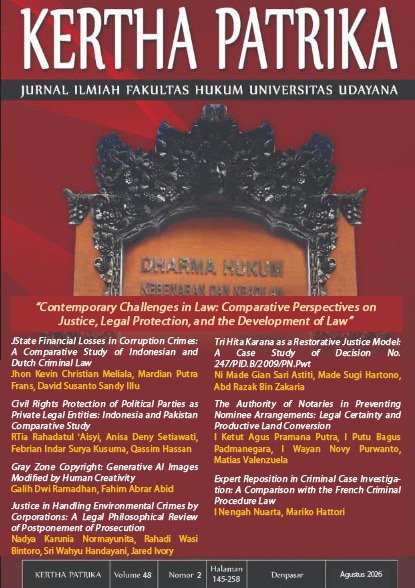
Civil Rights Protection of Political Parties as Private Legal Entities: Indonesia-Pakistan Comparative Study Post Constitutional Court Decision Number 60/PUU-XXII/2024
DOI:
https://doi.org/10.24843/KP.2026.v48.i02.p02Keywords:
Constitutional Court, Performance Restriction, Private Legal Entity, Political Parties, Pakistan ComparisonAbstract
Political parties in the Indonesian legal system act not only as political entities but also as private legal entities (rechtspersoon) possessing absolute civil rights. However, Article 40 of Law No. 10/2016 on Regional Elections, which imposed a nomination threshold based on legislative seats, restricted the legal capacity of non-parliamentary parties and negated the utility of valid votes as the organization's intangible assets. This normative legal research aims to analyze the implications of restoring the civil rights of political parties following the Constitutional Court Decision No. 60/PUU-XXII/2024, while expanding the analysis through a comparative approach with Pakistan's legal framework under the Political Parties Order (PPO) 2002. The results indicate that the Constitutional Court Decision No. 60/PUU-XXII/2024 serves as a restorative instrument that shifts the threshold basis back to valid votes to uphold the equality of legal entities. Based on the comparative synthesis, three typologies of regulatory models are identified: the Performance-Based Restriction Model (Indonesia pre-Decision 60/2024), the Compliance-Based Governance Model (Pakistan), and the Legitimacy-Based Proportionality Model (Indonesia post-Decision 60/2024). Through this comparison, Pakistan's experience demonstrates that the state can enforce internal party accountability without eliminating its fundamental civil right to nominate candidates, a governance direction that is now aligned with Indonesia's post-decision legal landscape.
Downloads
References
Afrohatul Laili, Anisa Rizki Fadhila. “TEORI HUKUM PROGRESIF (Prof. Dr. Satjipto Rahardjo, S.H.)” x, no. x (n.d.).
Ahmed, M, S Lodhi, and Z Ahmad. “Political Brand Equity Model: The Integration of Political Brands in Voter Choice.” Journal of Political Marketing 16, no. 2 (2017): 147–79. https://doi.org/10.1080/15377857.2015.1022629.
Alimsyah, S, and R Syam. “Constitutional Court Decision No.60/Puu-XXII/2024 Protects the Constitutional Rights of Citizens and Political Parties in Simultaneous Regional Elections in the Regions.” LITERATUS 6, no. 2 (2024). https://doi.org/10.37010/lit.v6i2.1712.
Aulia, M. Zulfa. “Hukum Progresif Dari Satjipto Rahardjo: Riwayat, Urgensi, Dan Relevansi M.” 1, no. 1 (2018): 159–85. https://doi.org/10.22437/ujh.1.1.159-185.
Bachmid, Fahri, and Diana Rachmitasari. “The Supreme Court’s Authority: Judicial Review of Statutes and By-Laws of Political Parties against Laws.” LAW REFORM 18, no. 2 (2022). https://doi.org/10.14710/lr.v18i2.46275.
Cherevko, P. “Evolution of Legal Capacity of a Legal Entity in Civil Law.” Analytical and Comparative Jurisprudence, no. 6–1 (2025): 84. https://doi.org/10.24144/2788-6018.2025.06.1.84.
Farisi, M, H Ardiana, B Bahren, and R Harahap. “ICCPR and the Future of Political Rights: A Critical Analysis of Existing International Legal Norms.” Uti Possidetis: Journal of International Law 6, no. 2 (2025): 43388. https://doi.org/10.22437/up.v6i2.43388.
Fikri, A, and F Syam. “Legal Politics Of Regional Head Elections With One Candidate Pair Based On The Constitutional Court Ruling No. 60/PUU-XXII/2024.” International Journal Of Humanities Education and Social Sciences (IJHESS) 5, no. 4 (2026): 2098. https://doi.org/10.55227/ijhess.v5i4.2098.
Fikri, S. “Analisis Putusan Mahkamah Konstitusi Nomor 60/PUU-XXII/2024 Terhadap Hak Politik Dalam Perspektif Teori Kontrak Sosial.” Amsir Law Journal 6, no. 1 (2024). https://doi.org/10.36746/alj.v6i1.589.
Flassy, M, U Idris, and M Muttaqin. “IMPLEMENTING CONSTITUTIONAL COURT DECISIONS: CASE STUDY OF THE REVISION OF THE 2024 REGIONAL HEAD ELECTION LAW IN INDONESIA.” PETITA: JURNAL KAJIAN ILMU HUKUM DAN SYARIAH 10, no. 1 (2025): 732. https://doi.org/10.22373/petita.v10i1.732.
Fonotova, O, and L Belyaeva. “Bargaining Inequality: Ways to Overcome It in International Commercial Law and in Private International Law.” RUDN Journal of Law 27, no. 4 (2023): 1043–64. https://doi.org/10.22363/2313-2337-2023-27-4-1043-1064.
Fujiwara, Thomas, and Carlos Sanz. “NORMS IN BARGAINING: EVIDENCE FROM GOVERNMENT FORMATION IN SPAIN.” NBER Working Paper Series, 2017.
Gisca, V. “Practical Aspects of Patrimony Functions.” Competitiveness and Innovation in the Knowledge Economy, 2023, 27. https://doi.org/10.53486/cike2022.27.
Grykiel, J. “The Key Institutions Regulated in Book One (the General Part) of the Polish Civil Code.” Pravovedenie 65, no. 1 (2021). https://doi.org/10.21638/spbu25.2021.102.
Jitmau, S, S Naim, and S MuhAkhdharisa. “Implementation of the Principle of Equality Before the Law in the Dynamics of Indonesian Law.” JUSTISI 11, no. 2 (2025). https://doi.org/10.33506/js.v11i2.4088.
Kartiko, N, and S Soegiono. “Analysis of the Impact of Monopoly Practices in the Entertainment Sector.” Indonesian Journal of Applied and Industrial Sciences (ESA) 3, no. 2 (2024). https://doi.org/10.55927/esa.v3i2.8405.
Maftuh, M. “PARLIAMENTARY THRESHOLD IN CONSTITUTIONAL ELECTION IN 2019 (PHILOSOPHICAL REVIEW OF THE PRINCIPLES OF PEOPLE SOVEREIGNTY).” JIL : Journal of Indonesian Law 1, no. 2 (2020): 200–213. https://doi.org/10.18326/jil.v1i2.200-213.
Mahmudi, M. “PARTAI POLITIK SEBAGAI BADAN HUKUM DALAM SISTEM KEPARTAIAN DI INDONESIA.” Jurnal Hukum (Universitas Islam Malang) 9, no. 1 (2020): 16–32. https://doi.org/10.33474/hukum.v9i1.5046.
Mantera, Dewa. “Proses Demokrasi Melalui Pilkada Yang Berkualitas Menuju Pemimpin Bali.” Jurnal Bali Membangun Bali 1, no. 2 (2018). https://doi.org/10.51172/jbmb.v1i2.25.
Maulana, M. “Analisis Tantangan Konstitusional Dan Problematika Hukum Tata Negara Dalam Pelaksanaan Pilkada 2024.” Constitution Journal 3, no. 2 (2024). https://doi.org/10.35719/constitution.v3i2.114.
Nahak, I. “Implikasi Putusan MK No.60/PUU-XXII/2024 Terhadap Dinamika Partai Politik Dan Calon Perseorangan.” Doktrin: Jurnal Dunia Ilmu Hukum Dan Politik 3, no. 3 (2025): 5321. https://doi.org/10.59581/doktrin.v3i3.5321.
Nisa, M, A Widya, and A Kartika. “EKSISTENSI PUTUSAN MAHKAMAH KONSTITUSI DALAM RANCANGAN UNDANG-UNDANG PEMILIHAN KEPALA DAERAH.” Jurnal Hukum Samudra Keadilan 20, no. 1 (2025): 11341. https://doi.org/10.33059/jhsk.v20i1.11341.
Nugroho, R. “Reconstruction of the Mechanism of Nomination for President and Vice President in Elections in Indonesia.” Borobudur Law Review 4, no. 1 (2022). https://doi.org/10.31603/burrev.6905.
Orr, Graeme. “Private Association and Public Brand: The Dualistic Conception of Political Parties in the Common Law World.” Critical Review of International Social and Political Philosophy 17, no. 3 (2014): 332–49. https://doi.org/10.1080/13698230.2014.886384.
Pakina, R. “Recruitment and Regeneration Political Party: The Influence on Election of Regional Heads.” In Proceedings of the International Conference on Law, Economics and Health (ICLEH 2020), 2020. https://doi.org/10.2991/aebmr.k.200513.105.
Piddubna, V. “Features of the Legal Status of Political Parties as Legal Entities: Comparative-Legal Characteristics.” ScienceRise: Juridical Science, no. 4(26) (2023). https://doi.org/10.15587/2523-4153.2023.294272.
Prabu, N, and B Rumiartha. “Correlation Theory of A.V. Dicey Perspective of the Rule of Law in Indonesia.” Focus Journal Law Review 2, no. 1 (2022). https://doi.org/10.62795/fjl.v2i1.19.
Pramana, Syahla Ailani. “Teori Filsafat Hukum Friedrich Karl Von Savigny,” no. 2022 (2024): 1–8. https://doi.org/10.11111/praxis.xxxxxxx.
Prayugo, A. “Optimalisasi Sistem Proporsional Terbuka Melalui Perubahan Parlemen Threshold.” Journal of Administration, Governance, and Political Issues 2, no. 1 (2025). https://doi.org/10.47134/jagpi.v2i1.3409.
Prihatmoko, J. “Rekrutmen PDIP Dalam Pilkada 2020: Antara Strategi Pemenangan Dan Pelembagaan Partai Politik.” SPEKTRUM 19, no. 2 (2022). https://doi.org/10.31942/spektrum.v19i2.6655.
Rahmat, R, A Budiono, I Irawan, and B Santoso. “LEGAL CERTAINTY ON THE LEGALITY OF ESTABLISHMENT OF LIMITED COMPANY BASED ON FAIRNESS OF PANCASILA.” Russian Journal of Agricultural and Socio-Economic Sciences 134, no. 2 (2023). https://doi.org/10.18551/rjoas.2023-02.02.
Ramadhan, D, B Saebani, and Y Sutiana. “Tinjauan Siyasah Dusturiyah Kerhadap Putusan Mk Nomor 60/PUU-XXII/2024 Tentang Ambang Batas Pencalonan Kepala Daerah Pada Pilkada 2024.” Ranah Research : Journal of Multidisciplinary Research and Development 8, no. 1 (2025). https://doi.org/10.38035/rrj.v8i1.1871.
Rashkova, E, and I Van Biezen. “The Legal Regulation of Political Parties: Contesting or Promoting Legitimacy?” International Political Science Review 35 (2014): 265–74. https://doi.org/10.1177/0192512114533981.
Renner, Moritz. “Private Power.” In New Private Law Theory: A Pluralist Approach, 243–60, 2021. https://doi.org/10.1017/9781108760089.015.
Rini, W. “Calon Tunggal Dalam Pemilihan Umum Kepala Daerah Dan Konsep Demokrasi (Analisis Terhadap Pemilihan Kepala Daerah Kabupaten Blitar Tahun 2015).” Jurnal Cita Hukum 4, no. 1 (2016): 95684. https://doi.org/10.15408/jch.v4i1.2578.
Schuster, K, F Pukelsheim, M Drton, and N Draper. “Seat Biases of Apportionment Methods for Proportional Representation.” Electoral Studies 22, no. 4 (2003): 651–76. https://doi.org/10.1016/s0261-3794(02)00027-6.
Sihaloho, H. “Analisis Terhadap Putusan Mahkamah Konstitusi Republik Indonesia Nomor 60/PUU-XXII/2024 Tentang Ambang Batas Pencalonan Kepala Daerah Di Pilkada Tahun 2024 Menimbulkan Ketidakpastian Hukum Untuk Pilkada Berikutnya.” VYAVAHARA DUTA 20, no. 1 (2025). https://doi.org/10.25078/vyavaharaduta.v20i1.4629.
Skoropysova, N. “The Concept and Main Characteristics of the Corporate Reputation of Legal Entities in Ukraine.” Entrepreneurship, Economy and Law, no. 5(2) (2021): 34–38. https://doi.org/10.37634/efp.2021.5(2).7.
Soleh, M. “Aktualisasi Prinsip Negara Hukum Pasca Putusan Mahkamah Konstitusi Nomor 60/PUU-XXII/2024.” Konsensus : Jurnal Ilmu Pertahanan, Hukum Dan Ilmu Komunikasi 2, no. 2 (2025). https://doi.org/10.62383/konsensus.v2i2.669.
Supryadi, A, A Fiorinimantika, R Aminwara, F Fahrurrozi, and I Imawanto. “PENAFSIRAN KONSTITUSI TERHADAP PUTUSAN NOMOR 116/PUU-XXI/2023 TENTANG AMBANG BATAS PARLEMEN.” GANEC SWARA 18, no. 1 (2024). https://doi.org/10.35327/gara.v18i1.800.
Susanti, Meirina. “Dinasti Politik Dalam Pilkada Di Indonesia.” Journal of Governance and Civil Society 1, no. 2 (2018): 111–19. https://doi.org/10.31000/jgcs.v1i2.440.
Tőkey, Balázs, and Bernadette Somody. “The Concept of Legal Capacity in Private Law and Constitutional Law.” Studia Iuridica Lublinensia 33, no. 1 (2024): 263–78. https://doi.org/10.17951/sil.2024.33.1.263-278.
Verschuere, B, and J De Corte. “The Impact of Public Resource Dependence on the Autonomy of NPOs in Their Strategic Decision Making.” Nonprofit and Voluntary Sector Quarterly 43 (2014): 293–313. https://doi.org/10.1177/0899764012462072.
Yudhistira, D, and B Nurdin. “Dynamics of Legal Politics after Constitutional Court Decision Number 60/PUU-XXII/2024 Regarding the Party Wholesale System in the 2024 Regional Head Elections.” Indonesian Journal of Multidisciplinary Science 4, no. 3 (2024): 1039. https://doi.org/10.55324/ijoms.v4i3.1039.
Downloads
Published
Issue
Section
License
Copyright (c) 2026 Kertha Patrika

This work is licensed under a Creative Commons Attribution-NonCommercial 4.0 International License.